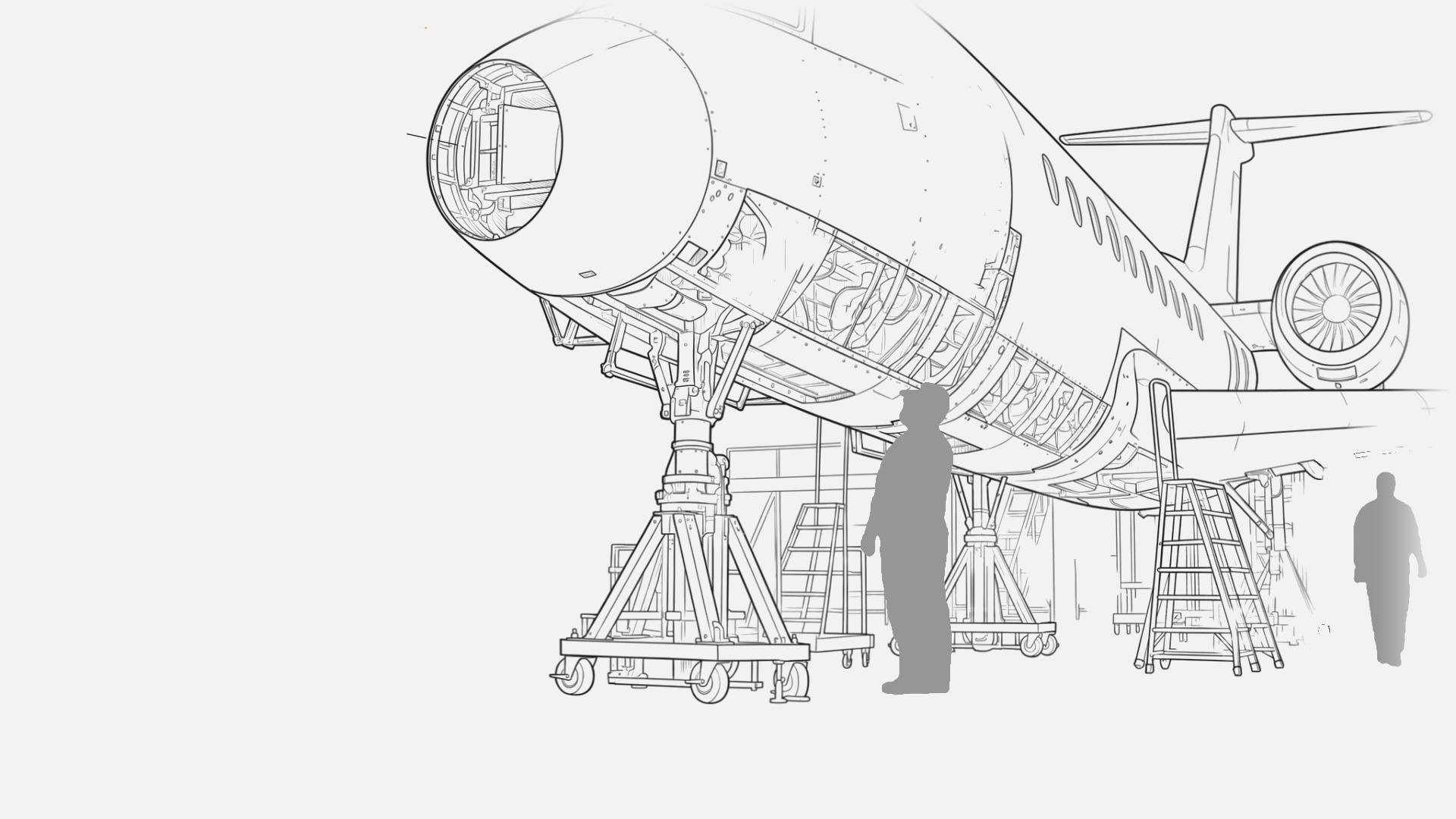

Most strategiesare good answers.Far fewer answerthe right question.
- 01The exam questionWhere we start: uncovering the context and the environment the question has to be answered within.Before any answer, we uncover the context: the market, the people, the pressures and what is fixed. That is the environment the question has to be answered within.
- 02DatumOne agreed account of what is true today, so every decision is measured from the same place.Measure from here. Before anyone argues about the future, we agree what is true now. Every judgement after that is taken from the same line.
- 03Load pathWhere the weight of a decision really lands in the business, and who has to carry it.Every force goes somewhere. We follow a decision through the organisation to find where it will bend, and who will be carrying it when it does.
Tap to skip

Act I · Group Partners
What we were asked.
What we asked back.
Every assignment arrives with the problem already named, and the work starts with what we ask back.
Act I · Group Partners
The wrong problem, solved beautifully.
Most organisations are very good at answering questions. Few check it was the right one.
In their words: what people bring us
We did the strategy last year. Why are we still talking about it?
Everyone agrees in the meeting. Then nothing happens.
We have more data than ever and less idea what it means.
The board wants an answer by the next meeting.
Act I · Group Partners
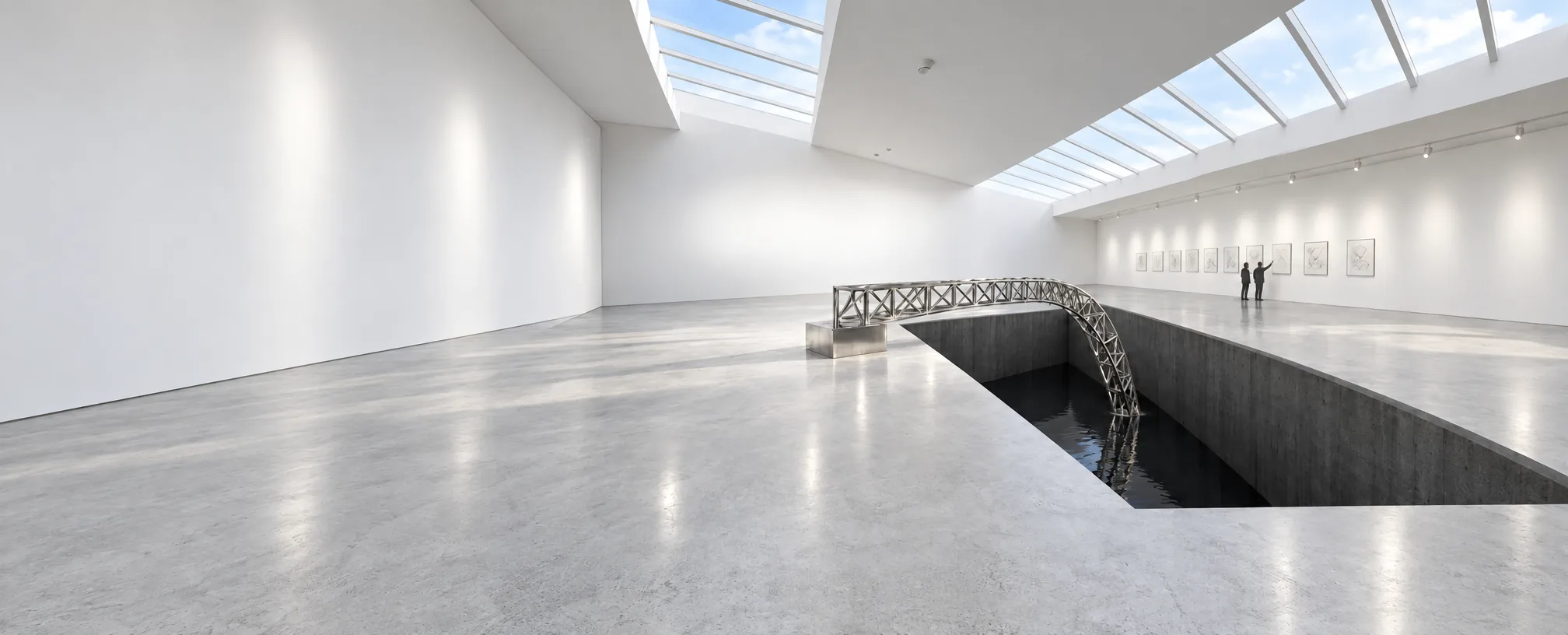
For 25 years we have watched talented organisations do something strange. They take a problem nobody examined and solve it beautifully: the people, the money, the months, all superbly engineered. And the bridge lands just to one side of the far bank.
It rarely fails in one dramatic place. The value leaks out at the joins: a brief nobody challenged, a session nobody prepared for properly, an insight that died in a report, a strategy that was announced and never declared.
Each one looks small. Add them up and you get the most expensive failure there is: a great deal of excellent work pointed at the wrong thing.
Name the last big initiative that delivered on time and on budget. Before it started, did anyone ask whether it was the right problem?
Play the snack "Wrong Problems" inline, without leaving the screen. Tap the bridge to see it on its own; tap again to bring the words back.
Script notes: visual
Plate: the bridge as a gallery installation, full bleed (preview). A span of polished steel girders starts on a plinth on the near side, reaches out over a channel of dark water cut into the floor, then curves down and dives nose first into the water short of the far bank. Callouts: the near bank, the span, where it lands, the far bank. The drawn bridge (s1-bridge-v1) is kept on file, no longer shown.
The story
Medals all round. For 25 years we have watched talented organisations take a problem nobody examined and solve it beautifully. Effort and money go in, and the work is praised on the day. Medals all round.
Leaks at the joins. Each handover looks small, and each one is somebody else's problem. Added together, the leaks rarely show on any single invoice. They show up later, as a strategy that was executed well and changed very little.
Seen everywhere. We have seen it from global enterprises to new entrants, through change and the search for new opportunity. Group Partners exists to stop it happening, and that begins by asking the question again.
The first drawing. In the first drawing of this bridge, the near bank read current problem and the far bank read future stability. The span between them was the path to sustainable outcomes.
Most of the advice business sells the middle: the workshop, the report, the deck with the nice cover. The value leaks out at the joins. A brief that was never challenged sets the wrong target.
A session nobody prepared for spends senior time discovering what should already have been known. An insight that lives only in a report stops working the day it is filed. A strategy that is announced but never declared commits nobody to anything.
Each handover looks small, and each one is somebody else's problem. So we think of an assignment as a chain, and hold ourselves to one rule: every stage has to create something the next stage depends on. If it doesn't, it is activity, and the client is paying for our exercise.
Add the four leaks together and the cost rarely shows on any single invoice. It shows up later, as a strategy that was executed well and changed very little.
The rest of this story is how that chain is built, where it is tested, and what is left when we have gone.
EXCELLENT WORK + THE WRONG QUESTION = BEAUTIFULLY EXECUTED NONSENSE
The bridge, keyed
- A Near bank · current problem: the problem as it was presented
- B The span · solved beautifully: the work itself, superbly engineered
- C Where it lands: excellent work, pointed at the wrong thing
- D Far bank · the right problem: where the organisation needs to be, never reached
Where the value leaks
- 01 The brief: never challenged before the work began
- 02 The session: nobody prepared for it properly
- 03 The insight: it died in a report
- 04 The strategy: announced, never declared
Proof
- From the practice: a brief usually arrives with the problem already named, and usually it is a symptom.
Sources: The Floor Above the Work, Part One: the nine movements
Evidence
Distance
Leaders rarely lack intelligence. What they lack is distance.
Stand back. See the whole machine.

Up closeStanding back
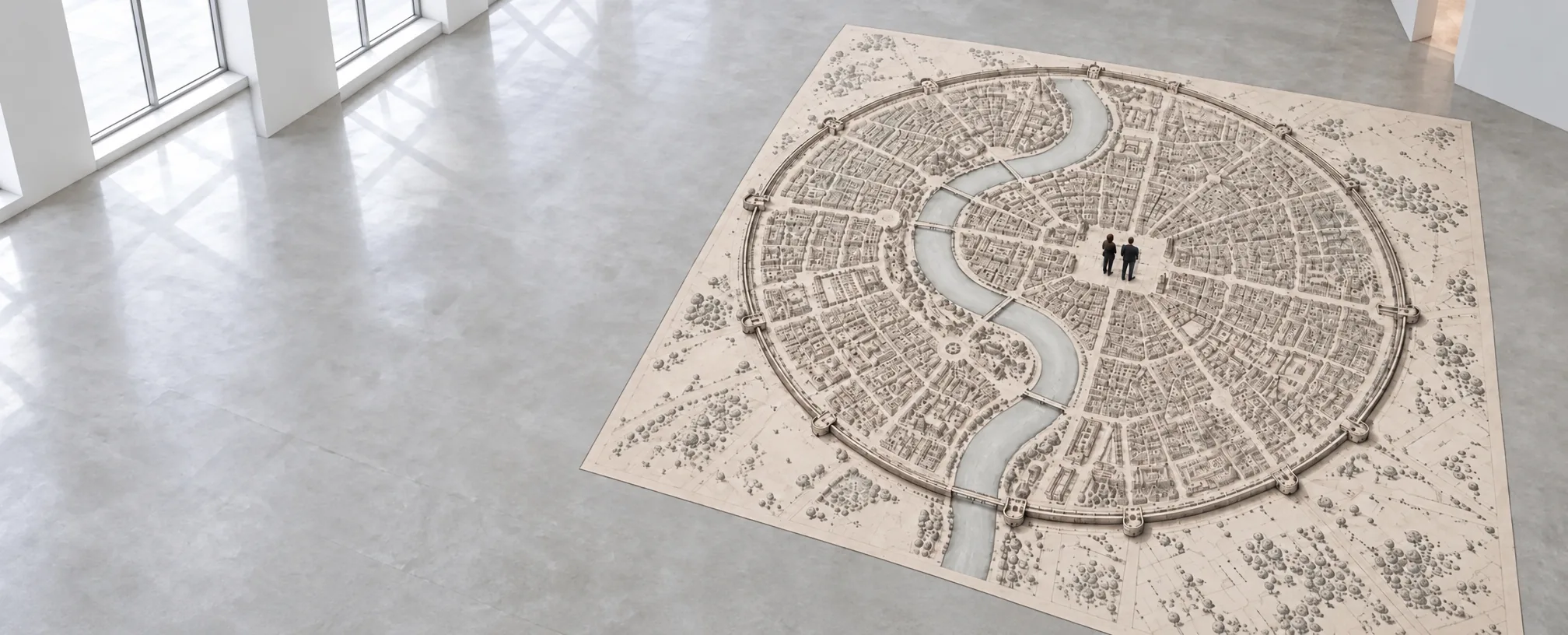
Read the plate from the inside out. Start with one component and the blocks that touch it, then take in the whole city inside its ring. Last come the joins, the bridges and gates where one part meets another, which is usually where the real problem sits.
Act I · Group Partners
Leaders rarely lack intelligence. What they lack is distance. Every division sees its own piece clearly, which is rather why they are called divisions.
Our first job is to help a leadership team stand back and see the organisation whole. We hold it in three frames that last the whole assignment: the market around it, the operation inside it, and the strategy meant to join the two.
No part means anything on its own. The insight is in the relationships, and the real problem usually sits between the parts, not inside any one of them.
Ask three directors to draw the organisation on one page, separately. Compare where each one draws the edges.
Pull back through the plate yourself, at your own pace, from one box to the whole enterprise. Tap any part of the drawing for one line on what it stands for.
- Frame 1 The market: the outside: dynamics, customer and stakeholder needs, competition, value, focus
- Frame 2 The operation: the inside: the joined up value chain, capabilities, the operating model
- Frame 3 The strategy: what joins them: identity, intent, vision, goals, choices, the picture of achievement
- Lines Relationships: where the insight is
- Joins The gap between: where the real problem usually sits
Script notes: visual
Plate: metaphoric image (preview), in the architectural style. A vast plan of a circular city lies on a gallery floor, seen from high above; one grey figure stands inside it, lost among the streets, unable to see the shape that is plain from above. Callouts point at the figure's own patch, the blocks around it, the ring that holds the whole and a gate where the city meets what lies outside it. Earlier idea, kept for the interactive: a slow pull back on a drawn plate, from one box to the whole enterprise.
The story
Distance. Leaders rarely lack intelligence. What they lack is distance, because every division is run and rewarded as a piece of its own.
A machine someone designed. Every business is a machine someone designed, so it can be redesigned. The people who run it are best placed to do that, once they can see the whole of it.
Seen whole. Seen from above, the organisation stops looking like departments negotiating with each other. It starts to look like one system with a few critical joins, and the real problem tends to show itself there.
A habit of mind. Standing back is a habit, and it can be learned. It is the first thing we teach and the last thing we leave behind.
A complex organisation is usually understood department by department, because that is how it is run, reported and rewarded. Each view can be accurate and still incomplete.
The three frames give every piece of evidence a home, and make each frame answer to the other two. A vision that ignores what the market is doing fails in the first. A set of choices the operation cannot deliver fails in the second.
An operating model with no link to what customers value fails in the third. The frames stay in place for the whole assignment, so nothing is overwritten: content accumulates and is dated, and the history of how the thinking developed can always be read.
Seen whole, the organisation stops looking like a set of departments negotiating with each other, and starts looking like one system with a few critical joins. Those joins are usually where the governing question comes from.
Distance is a habit of mind. It is the first thing we teach and the last thing we leave behind.
THE WHOLE = THE PARTS + THEIR RELATIONSHIPS
Three frames, keyed
- Frame 1 The market: the outside: dynamics, customer and stakeholder needs, competition, value, focus
- Frame 2 The operation: the inside: the joined up value chain, capabilities, the operating model
- Frame 3 The strategy: what joins them: identity, intent, vision, goals, choices, the picture of achievement
- Lines Relationships: where the insight is
- Joins The gap between: where the real problem usually sits
Standing back, in four moves
- 01 One component: what each division sees clearly
- 02 Its neighbours: what it touches and depends on
- 03 The whole: market, operation and strategy in one view
- 04 The joins: where the parts disagree
Proof
- A rule of the practice, from framework science: meaning is relational. Fragmented analysis is a warning sign.
- The same three frames hold every assignment, from the first conversation to the last review.
Sources: Strategy with Integrity: Practitioner Framework (June 2026); the three domain frameworks
Evidence
Groundwork
Sense it before the first session.
Before anyone gathers, we read how the organisation sees itself and how its customers are likely to think.

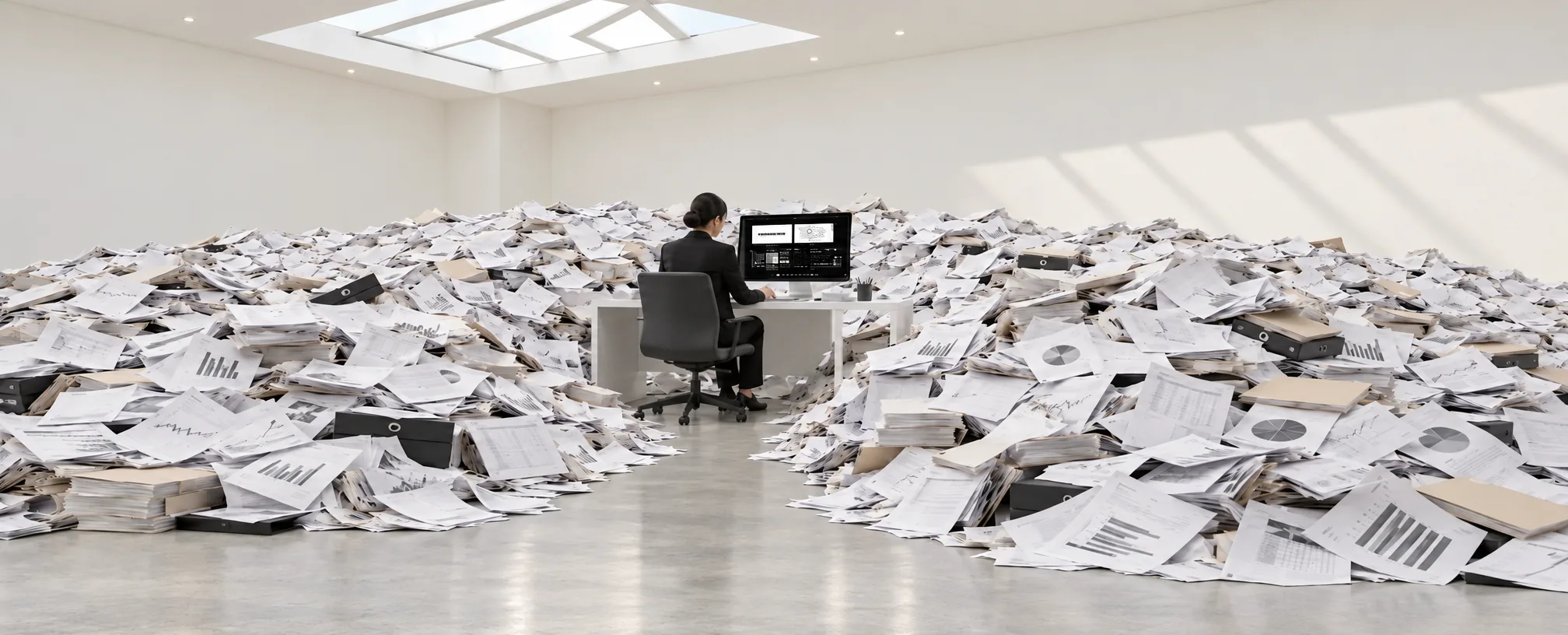
By the first session, nobody starts from a blank page.
Act I · Group Partners
Every assignment starts with groundwork, usually four to five weeks of it. We read what already exists, commission independent research, and run a set of strategic health assessments, each person scoring alone. Alongside them, digital twin panels, built from real human input and modelled on real segments, show how customers are likely to think and behave.
With the assessments, the pattern matters more than the average. A high average with wide disagreement is contested ground, the most dangerous place to be, because everyone believes the team is aligned when it isn't. A low score that everyone agrees on is a gap acknowledged, and much healthier.
None of this replaces the sessions. It means the first conversation starts closer to the truth.
Ask your top team to score one statement, each person alone: “Our strategy is clear enough that the people delivering it could explain it.” Then look at the spread, not the average.
Ask a digital twin panel a question, chosen from three prompts, and see how each customer segment reacts, all at once. Then drag a slider from the assumed customer to the sensed customer and watch the profile redraw.
Script notes: visual
Plate: v3.0 scene. The groundwork schema at real scale, with John as the ruler and the audience facing it. Client names on the drawing are painted out.
The story
Four to five weeks. Every assignment starts with groundwork, usually four to five weeks of it. The first read goes to the sponsor before anyone gathers, so the first session spends its time on what is genuinely uncertain.
On every assignment. The strategic health assessments are used whether or not a client chooses Mezzanine. The pattern matters more than the average, because a team can believe it is aligned when it isn't.
An example. We might test how a fashion retailer's customer segments react to a proposition before the sessions begin. It sharpens the ideal customer profile and our read of how customers behave.
Better now than later. The awkward finding is written down early, before the first meeting. Better now than in month six, and the first session starts closer to the truth.
Groundwork hands one thing on to everything that follows: an honest account of what is changing, what is true and what is merely believed.
The tools record what a team thinks. The assessments test where it actually stands. Each person scores alone, and the pattern matters more than the average.
High and scattered is contested ground. Low and agreed is a gap acknowledged.
Low and scattered is simply uncharted. High and agreed deserves a second look, because a record that looks too clean is rarely honest.
The digital twin panels are modelled perspectives, not real customers. They sharpen the picture of who the organisation serves and the questions worth asking of real customers.
They are a prompt for better questions, never a substitute for the evidence. What they say is weighed like any other evidence.
The first read goes to the sponsor before anyone gathers. Its job is to test the candidate question against the evidence before the group ever sees it, so the first session spends its time on what is genuinely uncertain.
THE PATTERN > THE AVERAGE
What goes in
- 01 Existing documents: what the organisation has already written down
- 02 Independent research: what is true outside it
- 03 Strategic health assessments: how it sees itself, each person scoring alone
- 04 Digital twin panels: how its customers are likely to think, modelled on real segments
- 05 First read: what is true, and what is merely believed
Reading the assessment
- High and scattered Contested ground: the most dangerous: everyone believes the team is aligned
- Low and agreed Gap acknowledged: healthy: the team knows what it lacks
- Low and scattered Uncharted: nobody has looked yet
- High and agreed Shared, or too clean?: test it: a record that looks too clean rarely is
Proof
- Discovery and framing typically runs about four to five weeks before anyone meets as a group.
Sources: Strategic Health Assessments v4; a short method note on digital twin panels, built from real human input (to write)
Evidence
Held in
The answer is already in their heads.
The problem on the brief is rarely the real one.

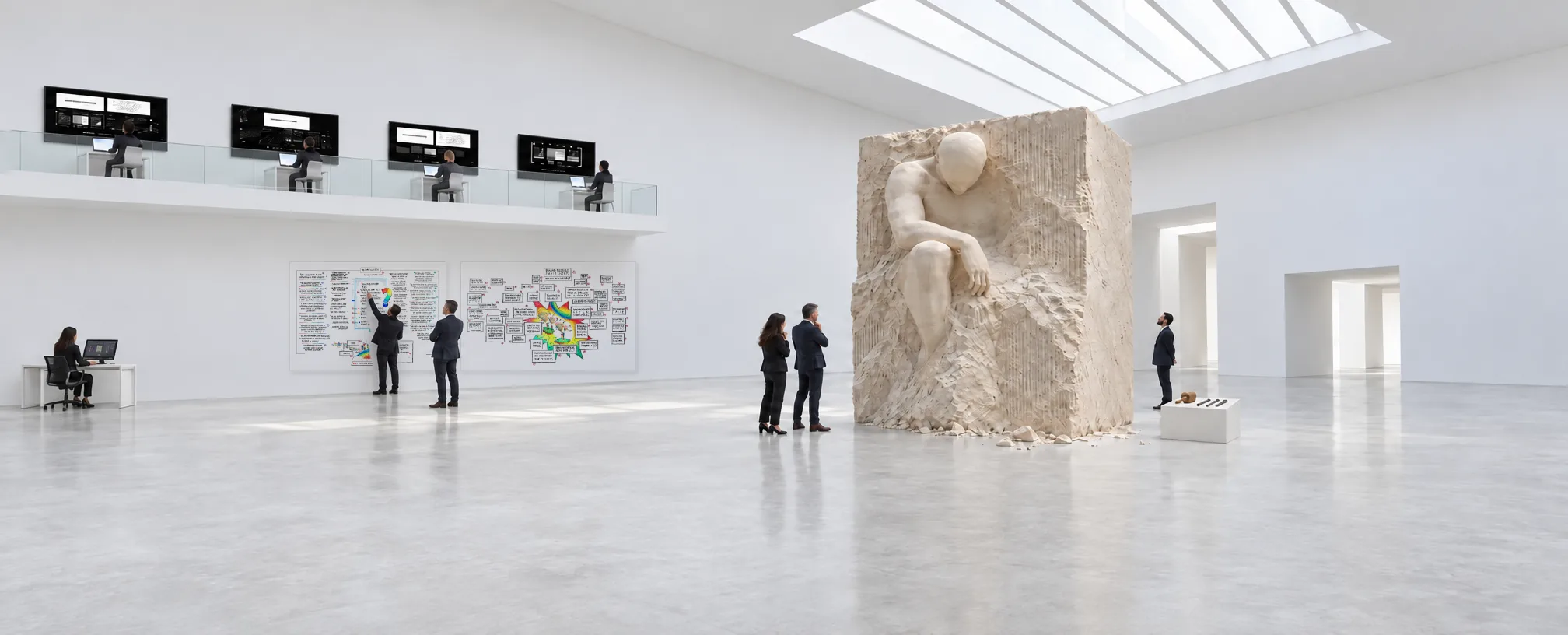
Four ordinary conditions keep it locked in. Each one can be designed out.
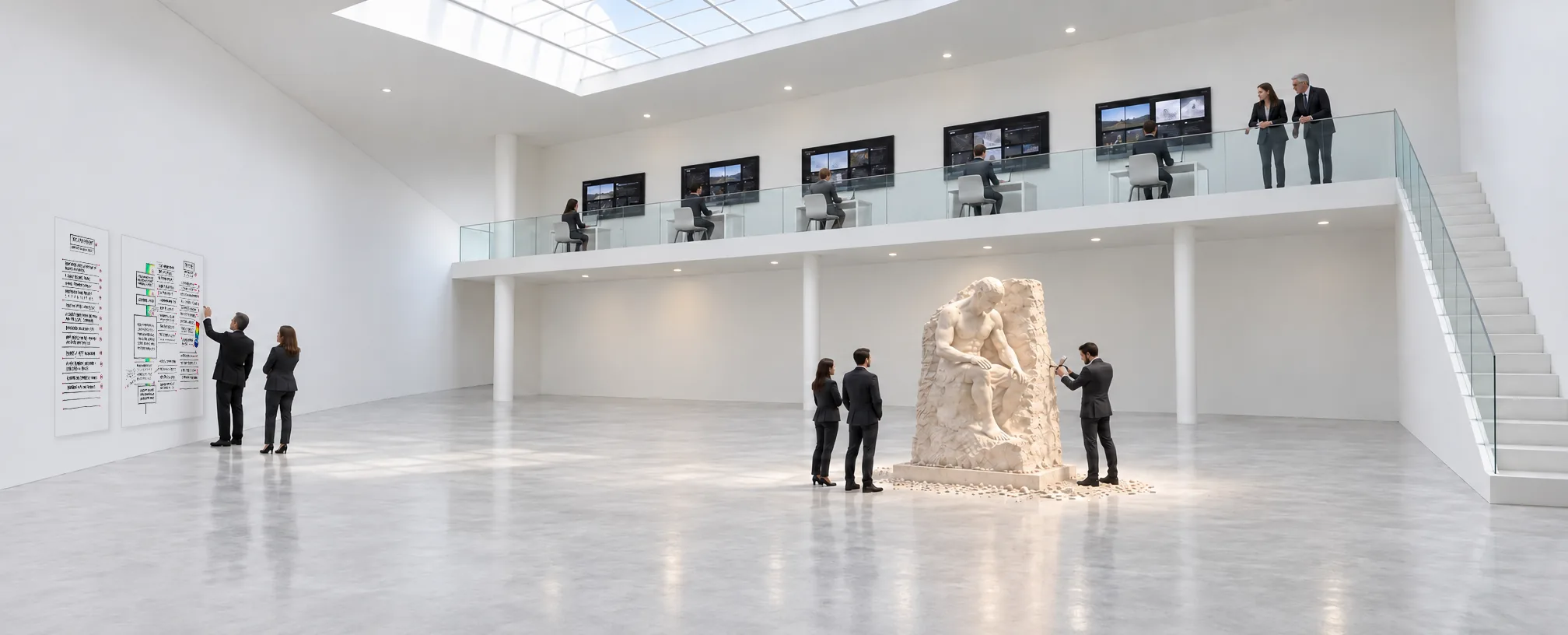
In the picture: Mezzanine upstairs, live screens. Framework Science, the black drum. A Structured Visual Thinking drawing. The answer, held in the stone.
Act I · Group Partners
The answer is rarely somewhere outside. It is usually in the heads of the people who do the work, held in by the organisation itself. Nobody has to become stupid for this to happen.
Divide the problem, reward agreement, hide the evidence, remove ownership, make dissent expensive, and a group of intelligent people will produce something none of them would have chosen alone. So before anything is drawn we listen, three ways: the sponsor, candid one to one conversations, and a wider group saying what keeps them awake.
What people won't say in a meeting, they say alone. We capture all of it, so none of that intelligence goes walkabout.
Read the six conditions. Tick the ones your organisation rewards without meaning to.
Drag a slider from the problem on the brief to the genuine challenge, and watch one drawing redraw itself as you go (two or three worked examples, clients anonymised).
Script notes: visual
Plate: metaphoric image (preview), in the architectural style. A monumental block of stone in a bright gallery, a figure half emerged from it: the answer is already inside, held in. Grey figures stand back and look. Callouts point at the freed leg, the parallel claw chisel marks, the rest of the figure still locked in raw stone and the tools set down on the plinth with nobody holding them.
The story
Held in. The answer is rarely somewhere outside. It is usually in the heads of the people who do the work, held in by the way the organisation is arranged, which nobody designed for that purpose.
Listening, designed. So before anything is drawn we listen, to the sponsor first and then to people one to one, where they say what they would keep back in a meeting. Where candour needs cover, it is gathered privately and anonymised before anyone else sees it.
Their words, kept. We draw what we hear, in the words people actually used, exclamation marks included. Paraphrase is where intelligence quietly goes walkabout.
The genuine challenge. Somewhere in all of it is the genuine challenge, and it is rarely the one written on the brief. Name it properly and everything that follows changes.
If intelligence depends on its conditions, then the conditions are part of the intelligence. Organisations hold their own intelligence hostage in departments, meetings and grades.
Nobody designs it that way. It is what happens when the problem is divided, agreement is rewarded and doubt is expensive.
So listening comes first, and it is designed. The sponsor conversation produces a candidate question.
Recorded one to one conversations test it from different vantage points and surface what people will not say in a group. A wider questionnaire adds context without turning the work into a list of grievances.
Candour is protected. Where it is needed, it is gathered privately, synthesised and anonymised before anyone else sees it. Everything heard is kept, and becomes evidence for the question that comes next.
Conversations are recorded and kept, so the words people actually used survive into the work. Paraphrase is where intelligence quietly goes walkabout, and a sponsor hearing the exact words is often the moment the genuine challenge becomes clear.
THE BRIEF ≠ THE CHALLENGE
Six conditions that hold intelligence in
- 01 Divide the problem: each part solved, the whole unseen
- 02 Reward agreement: the easy yes beats the useful no
- 03 Hide the evidence: what is known is not shared
- 04 Remove ownership: nobody's question, so nobody's answer
- 05 Make dissent expensive: the doubt stays private
- 06 Automate the judgement: the answer arrives before the thinking
How we listen
- A The sponsor: what they need, why now, what is fixed
- B One to one: recorded conversations: what people say alone
- C The wider group: what keeps people awake, what is avoided, what must be protected
Proof
- From the practice: what people hold back in a group, they will usually say one to one.
Sources: The Floor Above the Work: movements 1 to 3; sponsor conversation, interviews, questionnaire
Evidence
Conditions for thinking
Sit alongside. Never opposite.
Not an army of consultants. The team that will live with the answer, equipped to find it.
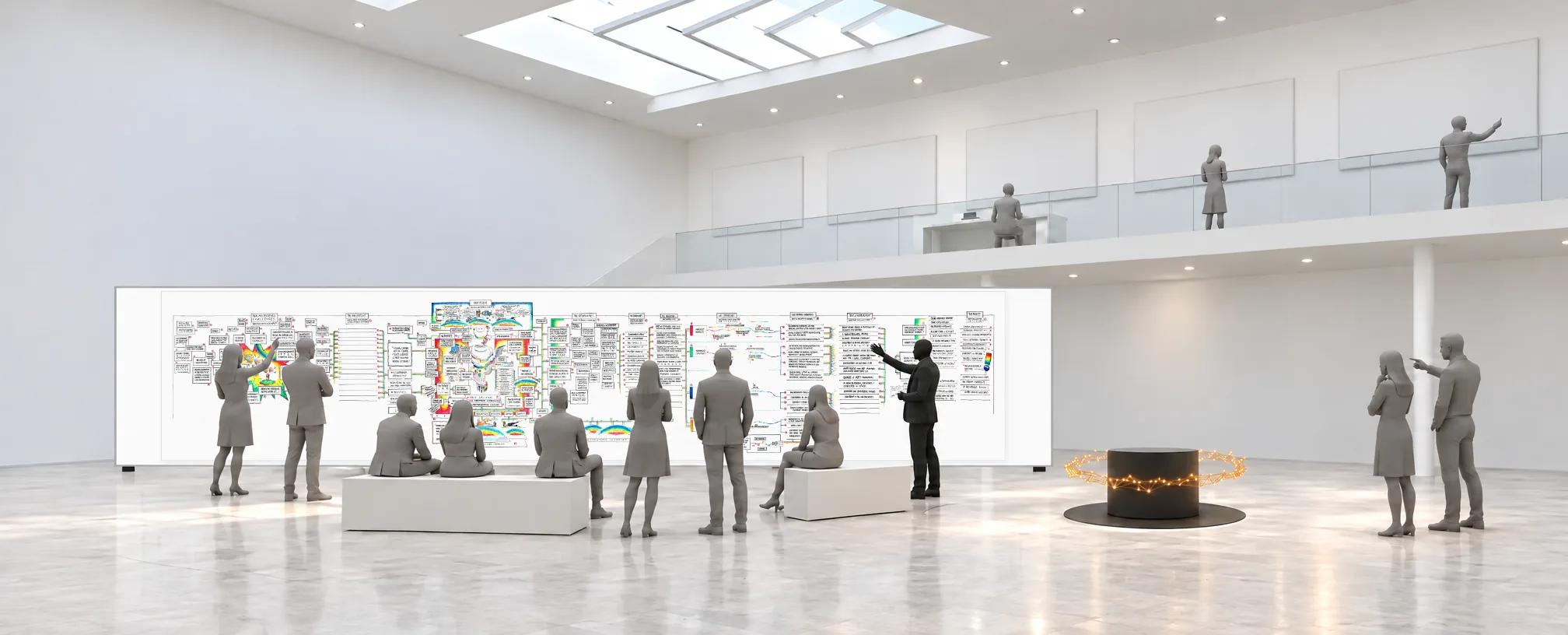
The drawing: a bespoke framework, typically seven to nine connected modules, from what is changing around the organisation to who commits to what.
Act I · Group Partners
From the question we design a bespoke framework, typically seven to nine connected modules, from what is changing around the organisation to who commits to what. The modules are not a left to right checklist. Outcomes can be looked at first and revisited.
- Dynamics: what is changing around the organisation
- Current reality: what is actually true today
- Imperatives: what the situation demands
- Vision: the future we intend to create
- Choices: the routes that could get us there
- Operating implications: what would have to be true inside
- Commitments: who commits to what
- Measures: how we will know it is working
A representative arrangement. Every framework is drawn for its own question, and the test along the foot stays the same: do the choices and actions add up to the outcomes we intend?
We have never believed in sending in an army. The people best placed to deliver a strategy are usually already inside the organisation. What they need are the right conditions to think together, so that is what we design.
Earlier we named six conditions that hold intelligence in. These are the six we put in their place: the whole problem in view, disagreement kept visible, the evidence on the table, a question the group owns, a safe route for candour, and judgement that stays with people.
We sit alongside, never opposite, and the team holds the pen. Our work in the background is shown to them on purpose, so that at the right point they can carry on without us.
Before your next leadership meeting, ask who holds the pen. If it is the most senior person present, the answer is already written.
Hover or tap the client logos to light one kind of organisation at a time: global enterprises, institutions, new entrants. Open "What the team keeps" for the techniques that stay behind.
- The team: holds the pen
- The framework: holds the argument
- The practitioner: sets it up, keeps it honest, hands it over
- What stays: the techniques, the frameworks, the habit
Script notes: visual
Plate: metaphoric image (preview), in the architectural style. A long table in a bright gallery with the whole team seated on the same side, facing one large hanging sheet they draw on together: alongside, never opposite. Callouts point at the framework on the sheet, the hand adding a line, the papers on the table and the last person in the row, facing the same question as everyone else.
The story
No army. We have never believed in sending in an army. The people best placed to deliver a strategy are usually already inside the organisation, and what they need is a safe space to think together.
Hearts and minds. They also need someone who earns their hearts and minds. We bring techniques and frameworks the team can use for themselves, and leave them more capable than we found them.
The craft, shown. A practitioner works behind all of it, choosing the questions and keeping the frameworks alive when the team goes quiet. That craft is shown to the team on purpose, so that at the right point they can carry on without us.
Their thinking, on show. Each session's drawing stays up, so the team reads its own thinking back. Experts are held back until the problem has shown itself, so their answers arrive after the question.
“A useful tool leaves you more capable when you put it down.”
John Caswell, It's All In Our Imagination (2027); Substack Note, 23 Oct 2026, verified against the V21.8 manuscript
A practitioner sits behind all of it: setting the stage, choosing the questions, keeping the governing question current, populating the frameworks and keeping them alive when the team goes quiet. None of that is new. Practitioners have always done it in the background.
The difference is that the client can now see it, and is brought into it deliberately, so that at the right point they can carry on without us. Experts are held back until the problem has shown itself, so their answers do not arrive before the question.
What stays behind is the point: the techniques, the frameworks and the habit of thinking together. The measure of a good adviser is how little they are needed next time. Each technique the team uses with us is one they can use again without us.
Candour has its own route. Where people need cover to say what is true, it is gathered privately, synthesised and anonymised before it is shared. The work stays open, and the people who need protection keep it.
THE CONDITIONS ARE PART OF THE INTELLIGENCE.
Six conditions we design in (each answers one on screen 4)
- 01 The whole in view: answers: divide the problem
- 02 Disagreement kept visible: answers: reward agreement
- 03 Evidence on the table: answers: hide the evidence
- 04 A question the group owns: answers: remove ownership
- 05 A safe route for candour: answers: make dissent expensive
- 06 Judgement stays human: answers: automate the judgement
Who holds what
- The team: holds the pen
- The framework: holds the argument
- The practitioner: sets it up, keeps it honest, hands it over
- What stays: the techniques, the frameworks, the habit
Sources: 2026 GP Generic Proposal (programme phases, how we engage)
Evidence
Lived experience
We have sat in your seat.
We know what has to land on the Monday morning after a good session.
Act I · Group Partners
We know what this asks of people because we have been on the other side of the table. We have been the client, commissioning the work. We have run complex programmes with real budgets and real deadlines.
And we have spent years alongside chief executives and their boards. That teaches you a few things a pure adviser can miss. The day job pulls everyone back within weeks.
The handover is where value has always leaked. The people delivering usually see the truth before the people leading.
And if the person with the power to say no isn't part of the process that produced the yes, the strategy is theatre. That is why the work is built to be used, not admired.
Who in your organisation could stop your strategy tomorrow? Were they part of making it?
Hold on the image to hear a short voice note from the practice (optional, to record).
Script notes: visual
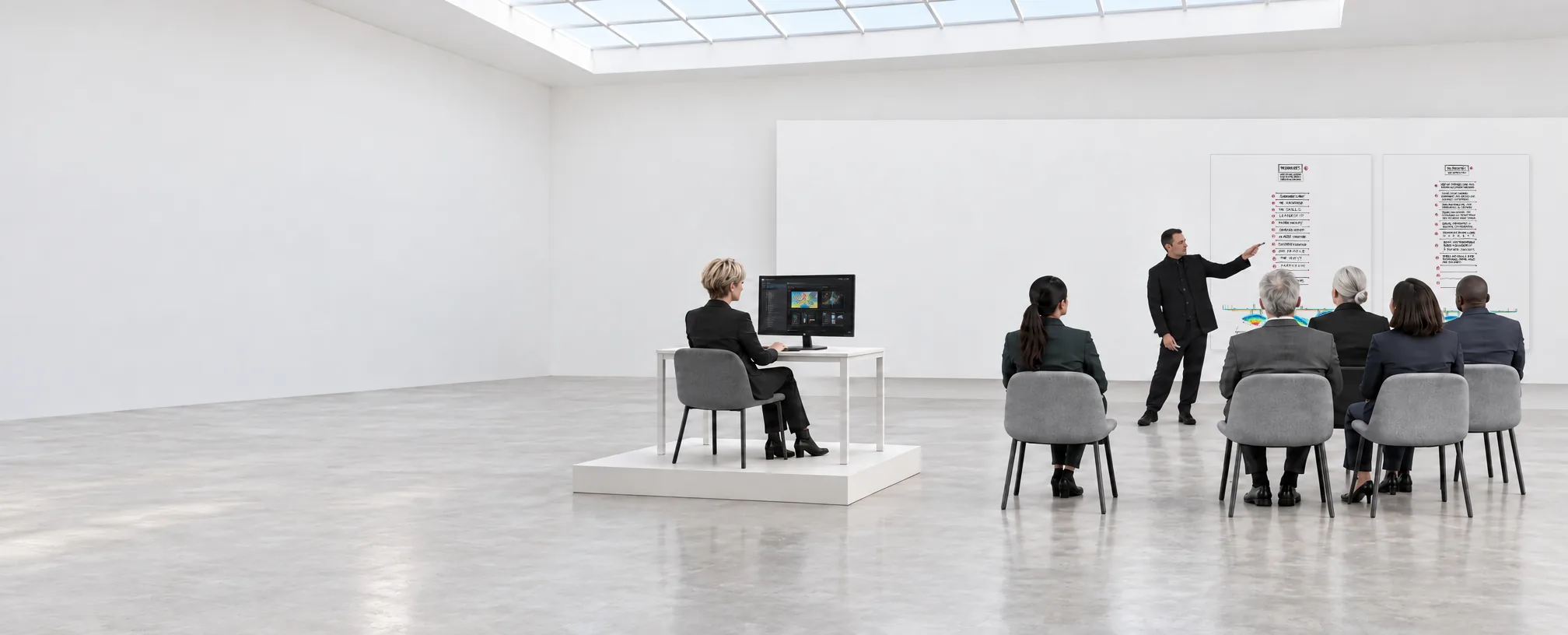
Plate: v3.2 scene. The blueprint end to end at real scale, with John as the ruler pointing to the audience, and our head of methodology and Mezzanine at her desk in the left foreground, a large Mezzanine screen on her desk. Client and personal names on the drawing are painted out.
The story
The other side of the table. We have been the client, commissioning the work, and we have run complex programmes with real budgets and real deadlines. Years alongside chief executives and their boards taught the rest.
Twenty minutes. Two thirds of the way through a strategy session with a famous retailer, the ideas were defensible and held together. Then the founder and Chairman, who had done none of the work, said no to every meaningful idea and walked out. Two months of preparation, undone in less than twenty minutes.
Since 2001. Group Partners has been at this since 2001, and the experience behind it goes back further still. Most of what follows was worked out in the sessions themselves, and written down only once we were sure it held.
Monday morning. So the deliverables are designed for the people who will use them on Monday morning. The plan traces back to the drawing, line by line: never follow a line you didn't draw.
“If the person with the power to say no isn't part of the process that produced the yes, any strategic thinking is theatre.”
John Caswell, It's All In Our Imagination (2027), “You Never Know What's In Store”, p.145 to 146 (read from V21.6; key lines match the V21.8 map)
Advice looks different from the client's chair. A good session is easy to admire on the day. What counts is whether it still works on Monday morning, when the people who were there are back in their day jobs and the people who were not there have to act on it.
Running programmes teaches the rest. The handover is where value has always leaked. The view from the delivery layer is usually closer to the truth than the view from the top, and the gap between the two is cheaper to close before action starts than during it.
And one lesson from years alongside boards above all: if the person with the power to say no is outside the process that produced the yes, the thinking was theatre. So the people who can stop the work are brought into making it.
None of this is said to impress. It is why the deliverables are designed for the people who will use them on Monday, not for the people who admired them on Friday.
THE YES NEEDS THE PERSON WHO CAN SAY NO.
Three seats
- Client side: we have commissioned the work
- The programme: we have run it
- The board: we have sat beside it
What the other side of the table teaches
- 01 The day job wins: within weeks, the reasoning lives in a handful of heads
- 02 The handover leaks: the oldest leak in the business of advice
- 03 The delivery layer knows: its view is almost always the more accurate one
- 04 The veto must be inside: whoever can say no helps make the yes
- 05 Monday morning: it has to make sense to people who never saw it drawn
Proof
- 25 years of practice, since 2001.
Sources: John Caswell, 2027
Evidence
Act II · Structured Visual Thinking and Framework Science
We do bring answers.
They come through structure.
We build the structure with the people who know the business, and the answers come out of it.
The governing question
One honest question governs everything.
“How do we grow?” is a horoscope. One honest question has to govern everything.
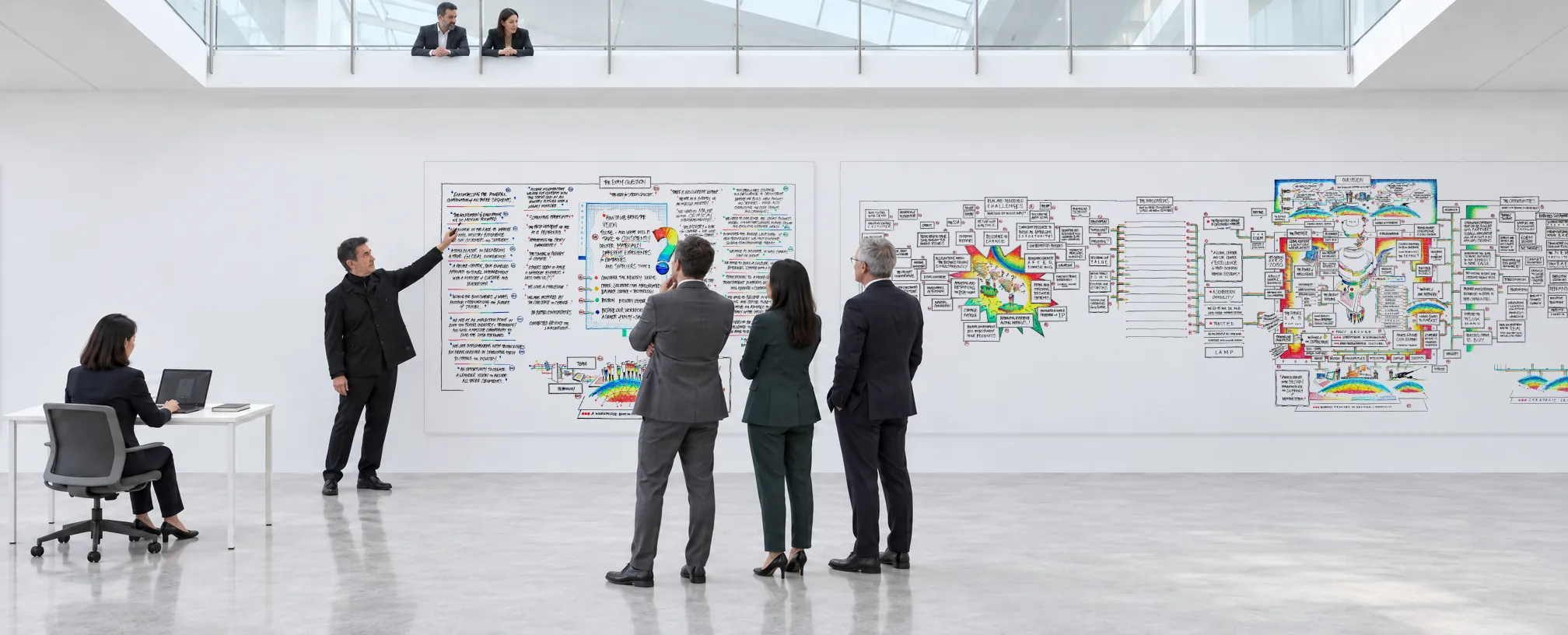
Every module answers to it, and every version of it is kept.
Act II · SVT and Framework Science
One honest question governs everything.
“How do we grow?” is a horoscope. One honest question has to govern everything.
Every piece of work is governed by a single governing question. It decides which information matters, who needs to be involved and which relationships deserve attention. A good one has three marks.
It is specific enough to be honest, broad enough to hold the whole enquiry, and genuinely uncertain: if the sponsor already knows the answer, it is a brief, not a question. It is formed in four steps, from the sponsor, through the one to ones and the wider group, until the group owns the words.
We push for the version that makes the sponsor slightly uncomfortable. Then it travels: every stage asks its own version, and at the end someone has to say, honestly, whether it was answered.
Write down your organisation's governing question. Test it against the three marks. If you cannot write it down, that is the finding.
Play the snack "The Exam Question" inline. Then try one of your own: type a question and see it held against the three marks of a good one, as prompts rather than a score.
- Mark 1 Specific: concrete enough that people recognise their own situation in it
- Mark 2 Broad: it cannot be answered in one session or by one choice
- Mark 3 Uncertain: if the sponsor already knows the answer, it is a brief
Script notes: visual
The central governing-question drawing (SVT module EQ, client name softened), slow push in to the question at its centre.
The story
The quiet killer. Drift is the quiet killer. The question shifts in conversation without anyone noticing. Six months later the strategy answers something adjacent with total conviction.
Made in four steps. The question starts with the sponsor and is tested in one to one conversations and a wider group, until the group owns the words. Along the way it is held against what the assessments and the digital twin panels showed.
It travels. Every stage asks its own version of the question, from discovery to deployment. At the end someone has to say, honestly, whether it was answered, and we write that moment in from the first day.
The governing question is the single defence against solving the wrong problem really well. Get it wrong and everything downstream is beautifully executed nonsense.
Drift is the quiet killer. The question shifts in conversation, nobody notices, and six months later the strategy answers something adjacent with total conviction.
So the question sits above the framework, never inside it as one more box. It can change, but every version is kept, and its history stays visible.
It has to be owned by the group before anything is drawn. If it isn't, the framework ends up answering the sponsor's private agenda.
And at the close, someone has to say whether it was answered. We write that moment in from the first day.
The question also decides the guest list. It determines which evidence is gathered, which people need to be involved and which relationships the framework has to hold, so a weak question quietly weakens everything chosen after it.
A good question is slightly uncomfortable for the person who commissioned the work. If it is entirely comfortable, it is usually protecting something, and the work will protect it too.
ONE QUESTION. ABOVE THE FRAMEWORK, NEVER INSIDE IT.
Three marks of a good question
- Mark 1 Specific: concrete enough that people recognise their own situation in it
- Mark 2 Broad: it cannot be answered in one session or by one choice
- Mark 3 Uncertain: if the sponsor already knows the answer, it is a brief
How it is formed
- 01 Sponsor conversation: a candidate question: what they need, why now, what is fixed
- 02 One to one interviews: does it land from different vantage points? If everyone agrees at once, it is not open enough
- 03 Wider questionnaire: context, without turning it into a list of grievances
- 04 Group ownership: the group shapes the words until they are theirs
It travels: each stage asks its own version
- Discovery: what is changing that bears on this question?
- Development: what would answering it look like, observably?
- Decision: are our choices enough to answer it?
- Deployment: are we executing in a way that answers it?
Worked example
- Before: “How do we grow?”
- After: “How do we build a strategy the whole leadership team will actually execute, given that we have never agreed on direction for more than six months?”
Proof
- The question goes into the record on day one: how it was arrived at, what answering it requires, every earlier version, and finally the verdict. Most engagements skip the verdict.
Sources: The Floor Above the Work: the exam question section
Evidence
Structured Visual Thinking
Out of their heads. Into the world.
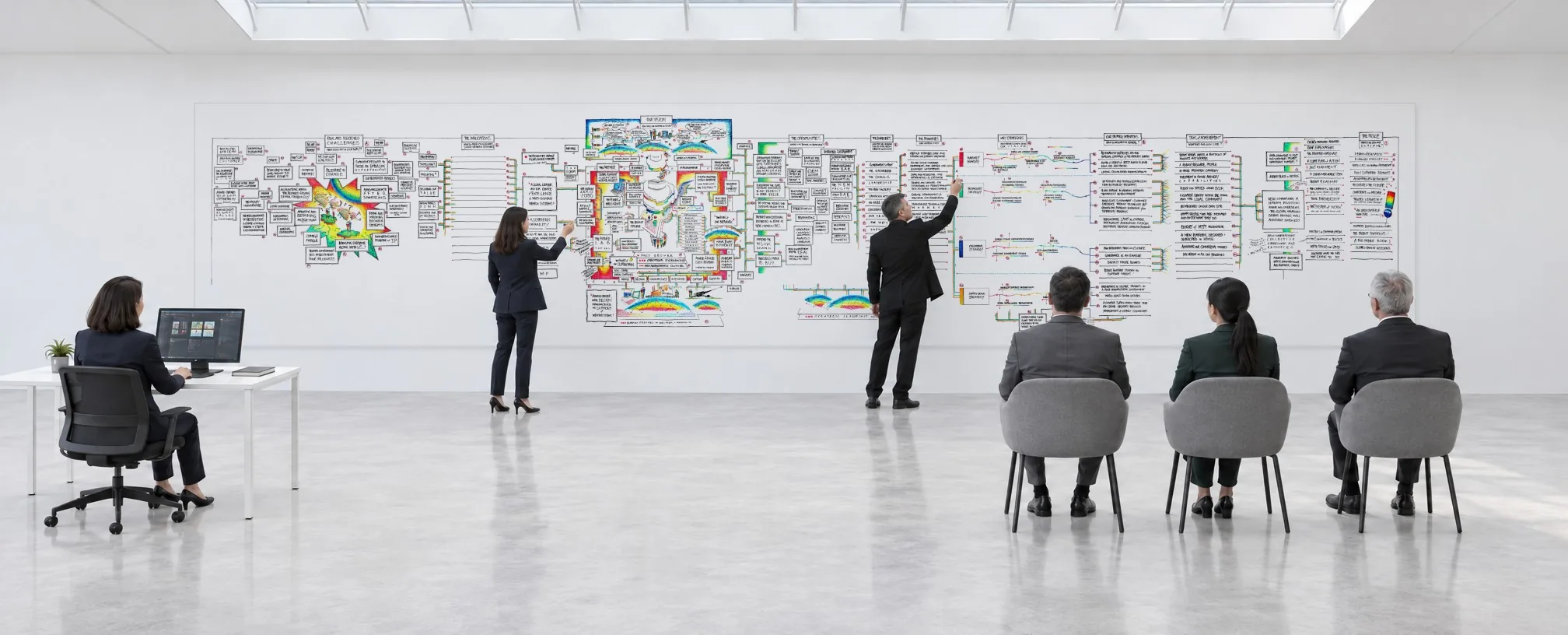
The whole problem drawn as one picture, so the people who will deliver it can reason about it together.
Act II · SVT and Framework Science
Out of their heads. Into the world.
The whole problem drawn as one picture, so the people who will deliver it can reason about it together.
This is the heart of it. Our method, Structured Visual Thinking, gets that thinking out and onto the table. From the question we design a bespoke framework, typically seven to nine connected modules, from what is changing around the organisation to who commits to what.
Then we draw it live, with the people who will deliver it. Put as one sentence, it is an equation: given what is changing and what is true, what future must we create, which choices could get us there, what must change in how we operate, who will commit to what, and how will we know it is working? Every contribution lands somewhere in it.
The test across the foot never changes: do the choices and actions add up to the outcomes we intend? The drawing gives their imagination a home.
Put your current strategy into the eight modules on one page. The empty boxes and the contradictions are your agenda.
Scroll the whole framework sideways, module by module. Tap any module to open the real drawing full size. The test along the bottom stays put while you move.
Script notes: visual
Real SVT drawings (modules A to D) laid out as one continuous framework, a slow pan across; a hand still drawing at one edge.
The story
A month of Fridays. It was a Friday, and the engineers and the sales team had been rambling for nearly forty minutes, as they had for a month of Fridays. Then a rough drawing of what had been said went up on a flipchart, boxes and arrows, messy and connected. People leaned forward and gathered round it.
A home for imagination. For the first time they had a physical thing to work with, and they disagreed with each other in a way that was useful. The drawing gave their imagination a home.
Never improvised. Our frameworks are drawn live, and each one rests on Framework Science. It is designed from first principles and refined wherever real assignments find it short, which is why it holds up under pressure.
Every line has a reason. Any recommendation can be followed back, link by link, from the review to the choice behind it and on to the question. A roadmap item with no choice behind it did not come from the enquiry.
“Drawing gives imagination its engineering logic. A fleeting daydream transforms into a structural possibility.”
John Caswell, It's All In Our Imagination (2027); Substack Note, 21 Oct 2026, verified against the V21.8 manuscript
Structured Visual Thinking starts with one question and ends with a business that adds up. Everything in between is about holding the problem still long enough for a group of senior people to reason about it together, instead of defending their corner of it.
The modules are not a left to right checklist. Outcomes can be looked at first and revisited. A vision changes when evidence contradicts it.
An operating implication exposes a strategy that will not work. When one relationship fails, the group goes back and builds a better account, and unresolved contradictions stay visible.
The drawing is part of the reasoning, not a record of it. The hand helps the brain know. And the third expression, the developed work that follows, is original thinking in its own right, well beyond the session drawing printed again in a nicer typeface.
Every contribution is placed and typed: fact, assumption, hypothesis, choice or constraint. That one discipline stops opinion arriving dressed as evidence, and makes the gaps visible enough to become the next questions.
GIVEN THE DYNAMICS AND THE CURRENT REALITY, WHAT FUTURE MUST WE CREATE, WHICH CHOICES COULD MAKE IT POSSIBLE, WHAT OPERATING CHANGES MUST FOLLOW, WHO WILL COMMIT TO WHAT, AND HOW WILL WE KNOW IT IS WORKING?
TEST LINE ALONG THE FOOT: DO THE CHOICES AND ACTIONS ADD UP TO THE OUTCOMES WE INTEND?
The business equation: a representative arrangement (no universal set)
- A Dynamics: what is changing around the organisation
- B Current reality: what is actually true today
- C Imperatives: what the situation demands
- D Vision: the future we intend to create
- E Choices: the routes that could get us there
- F Operating implications: what would have to be true inside
- G Commitments: who commits to what
- H Measures: how we will know it is working
Every contribution, four questions
- 01 Where does it land: which module of the equation?
- 02 What is it: fact, assumption, hypothesis, choice or constraint?
- 03 What does it touch: what does it support, what does it contradict?
- 04 What is missing: the gap becomes the next question
Tag key
- Fact: evidenced
- Assumption: believed, not yet tested
- Hypothesis: to be tested
- Choice: a route we could take
- Constraint: a limit we must respect
Three expressions of the work
- Prepared: designed before the session from the question and the evidence
- Live: the framework as the team builds it, tensions in view
- Developed: the authored deliverables that follow
Proof
- The picture on the board is a Structured Visual Thinking drawing made live in a past engagement.
Sources: The Floor Above the Work: SVT, the business equation and the drawn framework
Evidence
Failure modes
Different organisations. The same failure modes.
Hundreds of engagements. The same patterns.
Act II · SVT and Framework Science
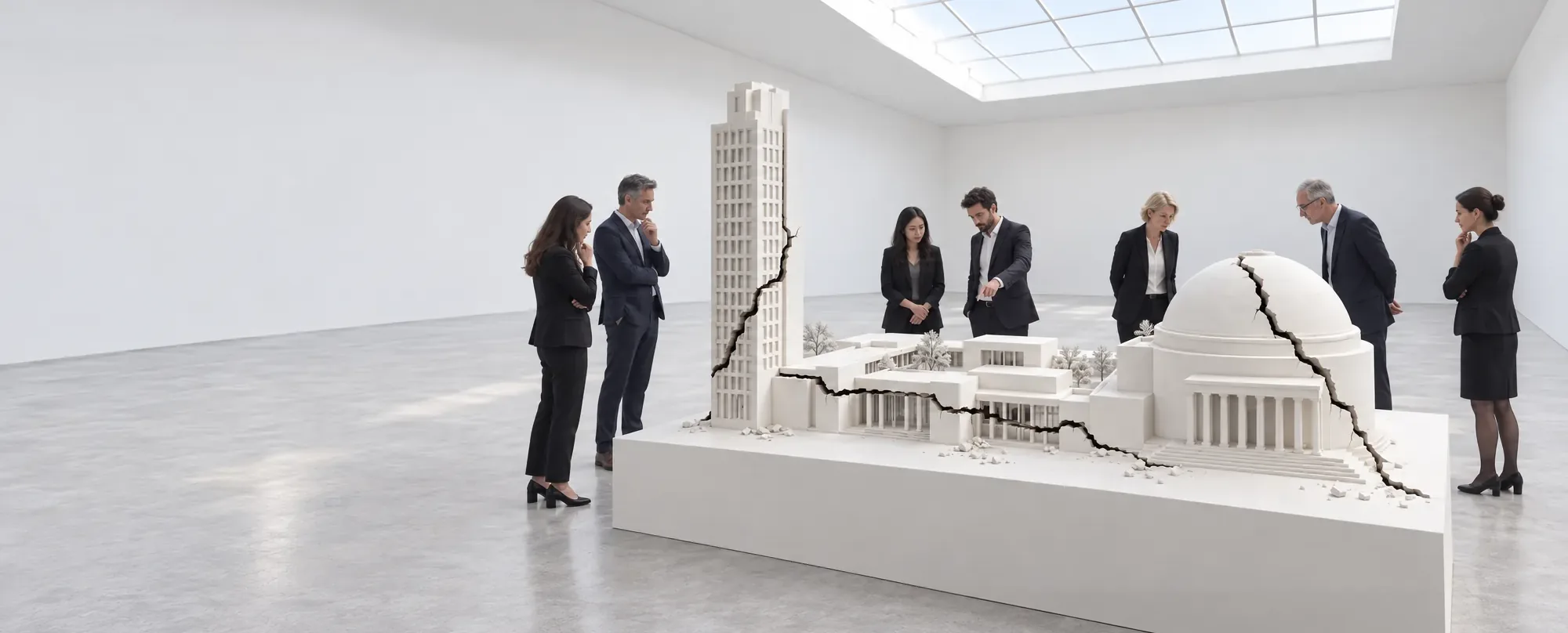
Work long enough, across enough organisations, and you see the same things again. A group that moves quickly through hard questions without friction: that speed is a warning, never alignment. Evidence that all points one way, gathered after the destination was chosen.
A strategy people can recite but can't explain. Leaders who think it is done, while the people delivering it know it isn't. And the convenient strategy: straw man alternatives, only supporting evidence, exclusions that cost nothing.
Three or more of those signs and a strategy is being justified rather than made. Every engagement taught us something, and our clients taught us most of it.
Run the six signs against your current strategy, honestly. Count them.
Turn over the tells one at a time, like cards. Each names a warning sign and why it misleads.
Script notes: visual
Plate: metaphoric image (preview), in the architectural style. Three very different white models, a tower, a low campus and a domed hall, pushed together on one plinth, with one crack running through all of them. Different organisations, the same failure modes. Callouts point at the tower, the crack where it crosses the campus, the crack splitting the dome and the plinth they all stand on.
The story
The same patterns. Every engagement taught us something, and our clients taught us most of it. Across hundreds of engagements the same things kept appearing, each one looking like progress from the inside.
The convenient strategy. Straw man alternatives and exclusions that cost nothing are its signs. When three or more appear, the picture was assembled after the destination was chosen.
Framework Science. For years this was instinct, what people called a black art. Framework Science is what happened when we wrote down why the work succeeded when it did, and why it failed when it failed. The patterns held across very different organisations, so they became rules, and the rules became instruments, tested in real assignments and refined wherever they fell short. Our most reliable test is still a question: what did you learn that changed your mind?
Too clean. One rule of thumb sits behind all of it. If the record looks too clean, it probably isn't honest.
The tells are the moments when work drifts from honest enquiry into justification. Each one looks like progress from the inside.
False consensus feels like alignment. The confirmatory scan looks like rigour and works as justification: the picture was assembled after the destination was chosen. Recited answers sound like commitment, but a memorised strategy fractures under pressure.
The seniority gradient hides in plain sight, and the delivery layer's view is almost always the more accurate one. Each tell is visible to anyone who knows to look for it.
One more pattern sits behind all five: the question drifts, and nobody notices. That is why the question is anchored at the top of the work and every version is kept. And a rule of thumb from all of it: if the record looks too clean, it probably isn't honest.
None of these is a failure of intelligence. Each is a condition, and conditions can be designed. That is the bridge from the patterns to the rules.
SPEED THROUGH DIFFICULTY IS A WARNING, NEVER ALIGNMENT.
Five tells
- 01 False consensus: hard questions passed without friction
- 02 The confirmatory scan: every signal points the same way
- 03 Recited answers: people can state the strategy, not explain it
- 04 The seniority gradient: leaders think it is done; delivery knows it isn't
- 05 The convenient strategy: justified, not made
Signs of the convenient strategy: count them
- a straw man alternatives
- b needs derived from the offer
- c only supporting evidence
- d assumptions nobody would dispute
- e exclusions that cost nothing
- f no discomfort under testing
Rule
- Three or more: the strategy is being justified rather than made
Proof
- Hundreds of engagements over 25 years. (Confirmed by you, 19 Oct.)
- Of the five, the seniority gradient is the one the declaration test measures directly: the gap between how leaders and the delivery layer score the same strategy.
Sources: The Floor Above the Work: five principles, integrity checks, red flags
Evidence
What the client keeps
25 years in the work. The client keeps it.
Every movement has to create something the next one depends on. If it doesn’t, it is activity.
Act II · SVT and Framework Science
25 Years in the work. The client keeps it.
Every movement has to create something the next one depends on. If it doesn't, it is activity.
Twenty five years in the work, and the shape of an assignment has settled into a chain of nine movements, from the first uncomfortable conversation with a sponsor to the day the organisation can carry on without us. Plan: establish the decision, discover, frame the question, design the framework. Build: the immersive sessions, the challenge, and the substantial work of developing and authoring the strategy.
Run: equip the organisation, then sustain and adapt. Each movement has to hand the next something it depends on.
And one principle has held throughout: what the work produces belongs to the client. Every session, drawing and conversation is captured and kept.
Map your last major programme onto the nine movements. Which one was skipped, and what did that cost?
Unfold the deliverable yourself: open each large drawing full size, zoom into the hand-drawn detail, turn from the overview to the frameworks behind it.
- The question and its history
- The frameworks: prepared, live and developed
- The strategy narrative and blueprint
- The operating model and roadmap, with named owners and measures
- The governance and review rhythm
Script notes: visual
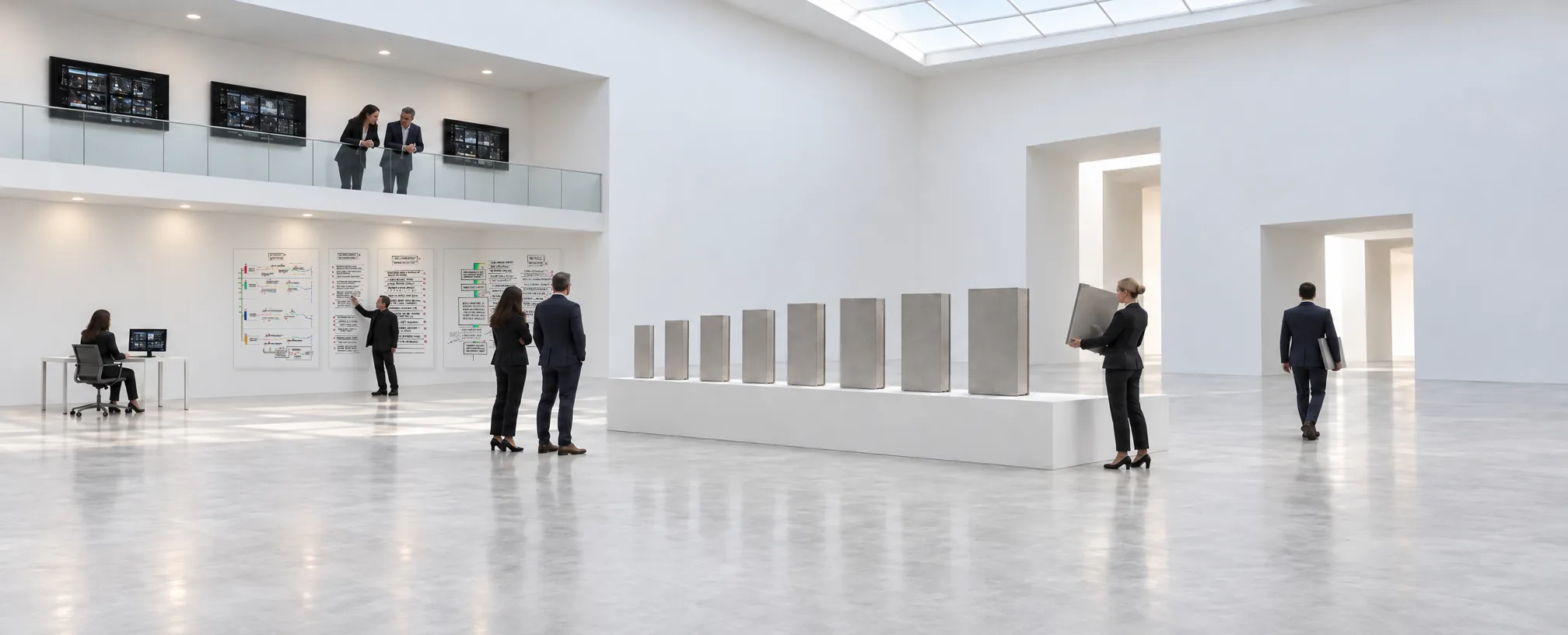
A live intervention session in a dedicated venue, the frameworks filling as the team works. Then the finished deliverable laid out on a long table: large hand-drawn visual documents and frameworks, client unnamed and unbranded, slow pan along the spread.
The story
A chain of nine. Twenty five years in the work have settled an assignment into a chain of nine movements. It runs from the first uncomfortable conversation with a sponsor to the day the organisation can carry on without us.
Loops are the point. The order is logical, and it still loops. Discovery changes the question, and an operating implication can kill an option everyone liked.
The sessions. The intervention sessions are days in dedicated venues, safe spaces where the people who will deliver can collaborate and co-create until the argument holds and is theirs. None of that is a warm-up.
Crafted to be used. What comes out is crafted visual documents and frameworks, drawn by hand and built to be worked from. The client owns them, so what the organisation knows stays with it.
The order is logical, never rigid. Discovery changes the question. Evidence reopens a choice.
An operating implication kills an option everyone liked. Those loops are the point.
Two joins matter most. Between movements 3 and 4, the question has to be owned by the group before anyone draws a framework.
Between 8 and 9 sits the oldest leak in the business of advice: the handover. Historically that is where the chain ended.
And the developed work in movement 7 is a piece of work in its own right. Treating the deliverables as a tidied photograph of the session is how strategies lose their depth. What the client keeps is substantial: built to be worked from, not filed.
Smaller pieces of work use part of the chain. The rule does not change with the size: each movement hands on something the next one needs, and the client keeps all of it. What is captured is dated and kept, so the history of how the thinking developed can always be read.
EVERY MOVEMENT HANDS THE NEXT SOMETHING IT CAN USE.
Plan
- 01 Establish the decision: hands on: a consequential decision someone owns
- 02 Discover and diagnose: an honest account of what is true and what is merely believed
- 03 Frame the governing question: one enquiry that decides what matters
- 04 Design the framework: an environment built for collective reasoning
Build
- 05 Engage the team: shared understanding, contradictions in view
- 06 Challenge the conclusions: positions that survived examination, or are honestly marked uncertain
- 07 Develop and author: a traceable, coherent strategic argument
Run
- 08 Equip the organisation: material people who were not there can use and act on
- 09 Sustain and adapt: a durable basis for judgement, without us
Timeline band (typical)
- Discovery and framing: about 4 to 5 weeks
- Synthesis and framework design: about 3 to 4 weeks
- Immersive sessions: 2 to 3 days
- Activation and handover: about 2 to 3 weeks
- Beyond handover: as long as it is useful
What the client keeps
- The question and its history
- The frameworks: prepared, live and developed
- The strategy narrative and blueprint
- The operating model and roadmap, with named owners and measures
- The governance and review rhythm
Proof
- Typical timings from the practice, as above: about four to five weeks of discovery and framing, three to four of synthesis and design, two to three days of immersive sessions, two to three weeks of activation and handover.
Sources: The Floor Above the Work: prepared, live and developed frameworks; a set of past deliverables, unbranded (to choose)
Evidence
Act III · Mezzanine
What we learnt.
What we leave behind.
What 25 years taught us, and what stays with the client when we have gone.
Reasoning
Strategies fall over when the reasoning gets lost.
So the thinking outlasts the session.
Act III · Mezzanine
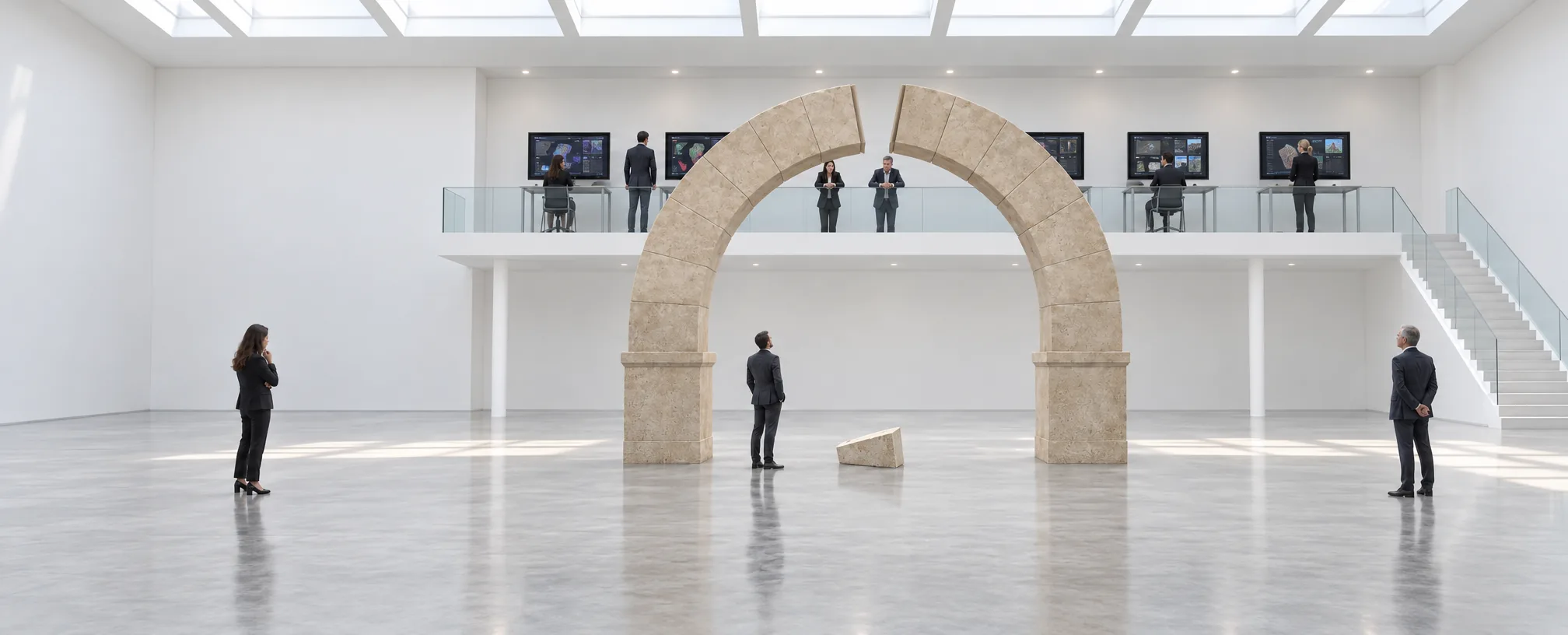
Strategies rarely fail because they were wrong. They fail when the reasoning behind them gets lost, long before anyone can tell. A workshop is an event, and thinking you want to sustain can't live inside an event.
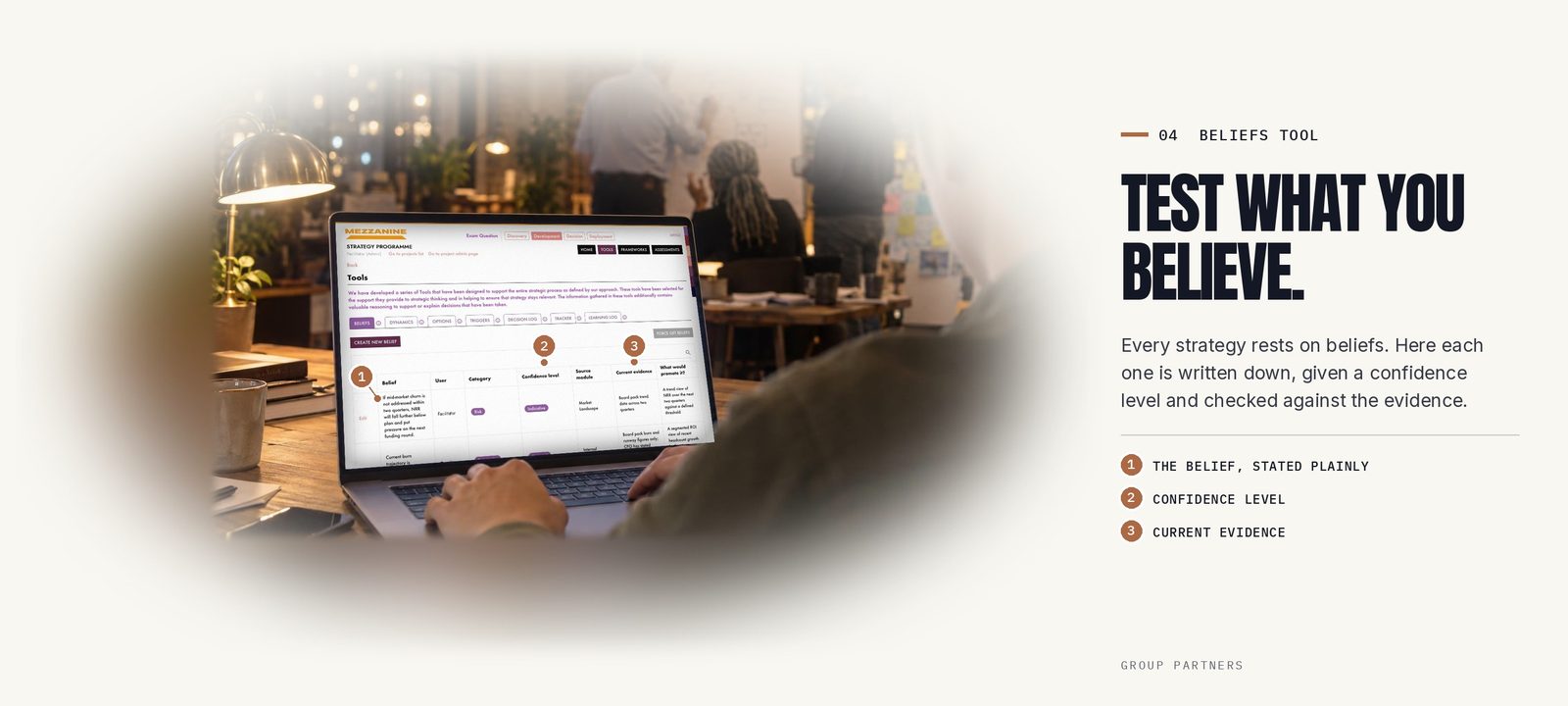
So where a client chooses it, our platform, Mezzanine, holds the work from the first week: the question at the top of every page with every earlier version kept, the beliefs, the choices and the roadmap. When something real changes, the change goes back to the stage that produced it, and the options set aside are still there. It won't make a team care.
Where the commitment is there, it stops it fading. The tools run at full power; the judgement stays with the people.
Ask where the reasoning behind your last strategy lives now. If the answer is a few people's heads, it is already fading.
Tap the splash, "Where strategy becomes the way you work", and step through the screen into the platform yourself.
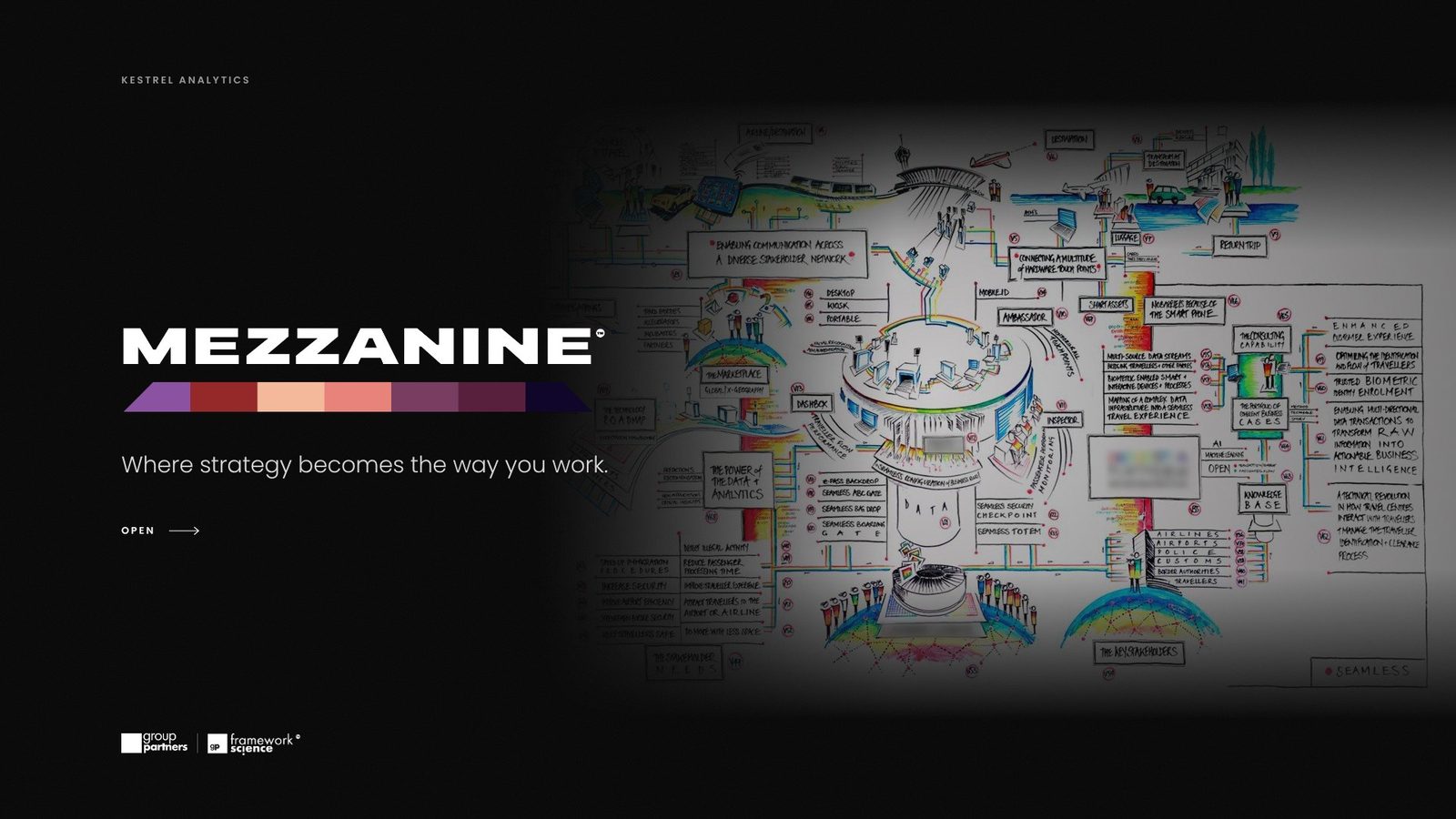
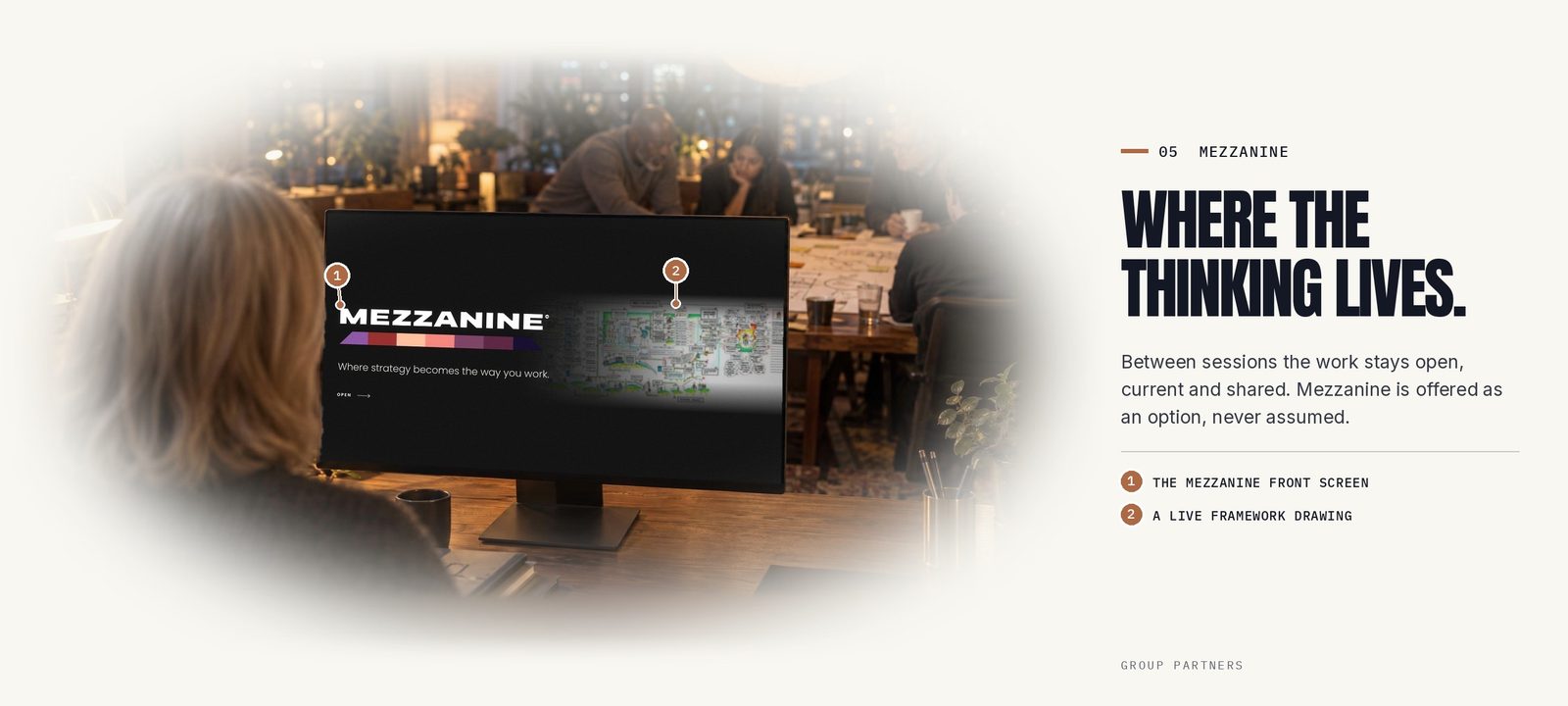
Script notes: visual
Plate: metaphoric image (preview), in the architectural style. A stone arch, framed tight, with its keystone missing: the gap at the crown is the point. The keystone lies on the floor below. Callouts point at the gap, the keystone on the floor, the stones still in place and the piers. Earlier idea, kept for the interactive: push in over an operator's shoulder at a desktop, where the real Mezzanine splash, "Where strategy becomes the way you work", fills the monitor, and we pass through the screen into the platform.
The story
An event. A workshop is an event, and thinking you want to sustain can't live inside an event. Within weeks the day job closes over it.
Back to the source. When something real changes, the change should go back to the stage that produced it. Without the reasoning, a team has nowhere to go back to and starts again.
Between sessions. Between sessions the thinking has to live somewhere, or it drifts. For clients who choose it, that place is Mezzanine, a floor just above the work, holding the question and the drawings together. Where it is not chosen, the work we leave carries the thinking.
“Distraction is the noise we choose. Traction is what holds when the noise stops.”
John Caswell, It's All In Our Imagination (2027); Substack Note, 20 Oct 2026, verified against the V21.8 manuscript
In a building, a mezzanine is a partial floor that overlooks the space below. It adds real use without a bigger footprint. It sits just above the day to day work: close enough to see it, high enough to see all of it.
Clients work in it from the first week, so it holds the reasoning as it forms rather than rescuing it after the fact. Sessions carry on; they become one valuable event among several. Before a session, what it holds shapes the frameworks we bring.
Afterwards, everything from the session goes back in. Nothing is overwritten: content accumulates and is dated.
The question sits at the top of every page, and every earlier version is kept. The question can change; its history stays visible. That one design choice is the answer to drift.
Is it for everyone? No. It will not make a team care.
If the commitment isn't there, a platform will not manufacture it. Where the commitment is there, it stops it fading the moment the session ends.
USE THE TOOLS AT FULL POWER. KEEP THE JUDGEMENT.
Five stages, one gate, three return paths
- 01 Foundations: the question formed and tested
- 02 Discovery: what is changing, what is true
- 03 Development: the vision, and the blueprint that mirrors it from the inside
- 04 Decision: choices the organisation can commit to, alternatives recorded
- Gate Declaring: shared, or merely announced?
- 05 Deployment: making it real, and keeping it honest as the world moves
Return paths
- A change of goal: back to development
- A change of choice: back to decision
- A change in what we believe about the market: back to discovery
House rules
- Anyone can add, and everyone can see everything
- A belief belongs to the person who made it; anyone can add a conflicting one
- Conflicts are information to understand, not errors to clear
Where the AI stops
- It uses only what this client's own work holds
- It surfaces gaps, contradictions and ambiguities; people decide
- Its synthesis is a draft until a practitioner has reviewed it
Proof
- Honest scope: it is for teams who want to keep working this way after the first sessions. They choose it; it comes with a practitioner's support and a few named people on the client side who keep it current.
Sources: The Book, Part Five: Mezzanine (internal, 16 Oct 2026)
Evidence
Live from minute one
It fills as the work happens.
Signed up at the start, it carries the whole assignment.
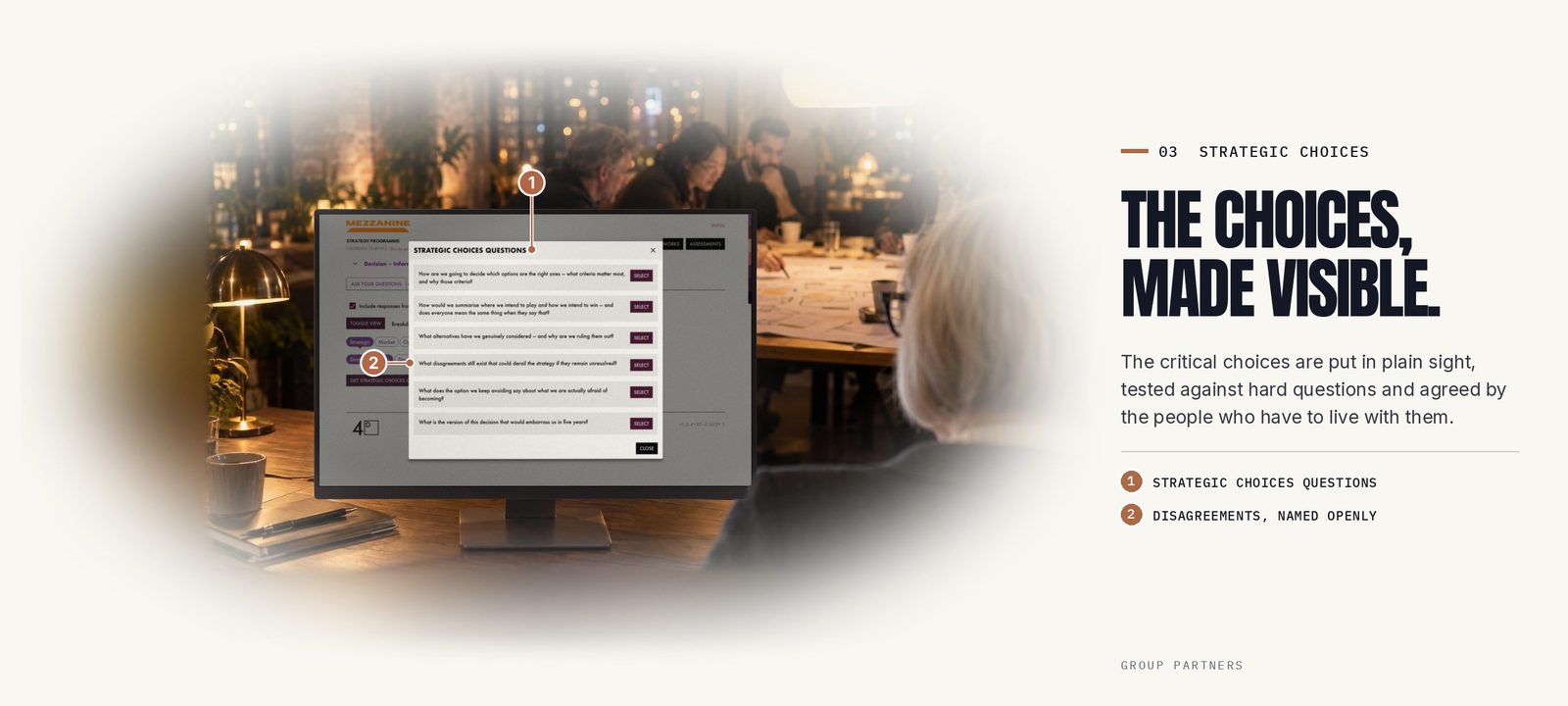
Act III · Mezzanine
Live from minute one
Signed up at the start, it carries the whole assignment from the first session on.
Mezzanine is designed to start the moment an assignment is accepted. That is why we ask clients who want it to sign up early. From the first session the system fills as the work happens: the question at the top of every page, every drawing and conversation, every choice as it is made.
Nobody arrives later to an empty system, and nothing learned is lost. Everyone sees everything, which is a large part of how a team aligns.
Follow one assignment from acceptance: tap through session one, two and three and watch the real Frameworks strip fill as each session lands. Scroll the strip sideways and tap any scroller to open the drawing inside it.
Script notes: visual
Real Frameworks screen with the hand-drawn scroller strip running sideways; the module drawings shown inside that screen, exactly as a client sees them. Cut to a mood shot of colleagues at a large monitor, mid-conversation.
The story
Captured anyway. Every session and every conversation is captured on every assignment, whether or not a client chooses Mezzanine. What the organisation knows stays with it.
Drawn by hand. A framework drawn by hand in the session is tested before it is trusted, and each conversation feeds it. Where a client chooses Mezzanine, the drawing on the table one day is the same drawing on screen the next morning.
Signed up early. Starting at acceptance means what it holds shapes the frameworks we bring to each session. Afterwards, everything from the session goes back in.
“Knowledge is in the hands.”
John Caswell, It's All In Our Imagination (2027); Substack Note, 16 Oct 2026, verified against the V21.8 manuscript
Its own instance. Each client gets its own Mezzanine, loaded with the material the organisation already holds before anyone logs in. Nobody starts with an empty system.
The question on every page. The governing question sits at the top of every page. Every earlier version is kept, so the question can change and its history stays visible.
Nothing overwritten. Everything from a session goes back in, drawings included, and the frameworks are regenerated. Content builds up and every change is dated.
Back to its stage. A validated change goes back to the stage that produced it. A changed goal returns to Development, a changed choice to Decision. Options set aside are kept as reserve positions.
The rules it runs on. Anyone can add and everyone sees everything. A belief belongs to the person who made it, and anyone can add a conflicting one, because a conflict is information.
The AI stays inside. It works only from what is in that client's instance, never the open internet or another client's work. It surfaces gaps and contradictions, and a person decides.
The stages, as the app shows them
- 01 Governing question: formed and tested first
- 02 Discovery: what is changing and what is true
- 03 Development: the future to create
- 04 Decision: choices made and declared
- 05 Deployment: owners, measures and triggers
An option
- Mezzanine is for teams who choose it. It keeps commitment going and cannot create it.
Sources: The Floor Above the Work; the Mezzanine app screens, October 2026
Evidence
Compression
Compression. Better decisions, sooner.
Agreement is easy when no one knows precisely what they are agreeing to.
Act III · Mezzanine
Compression. Better decisions, sooner.
Agreement is easy when no one knows precisely what they are agreeing to.
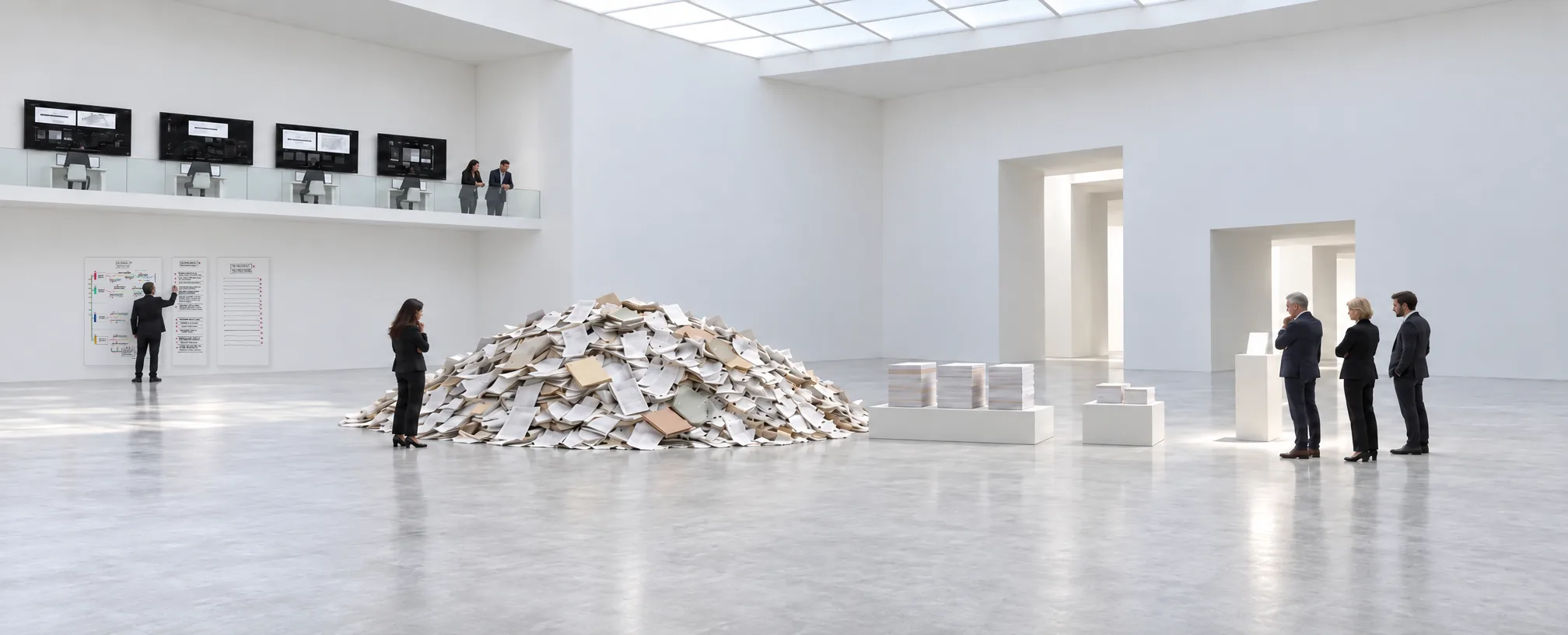
Organisations drown in material: reports, data, opinions, decks. The work compresses it, stage by stage, until what is left is the decision that actually has to be made, with the reasons in plain view. Compression is not simplification.
Nothing that bears on the question is thrown away, and the alternatives we set aside are kept, so if the world moves the team returns to options it already understands. Then the test that matters most: is the decision described, or declared? A description is easy to agree with because it commits nobody.
A declaration excludes alternatives, moves resources, names owners and states what would make us think again. Everyone had a paragraph.
Nobody had the story. Compression gives them the story.
Take your last big decision. Can you say what it excluded, what moved, who owns it and what would reopen it? Four yeses and it was declared.
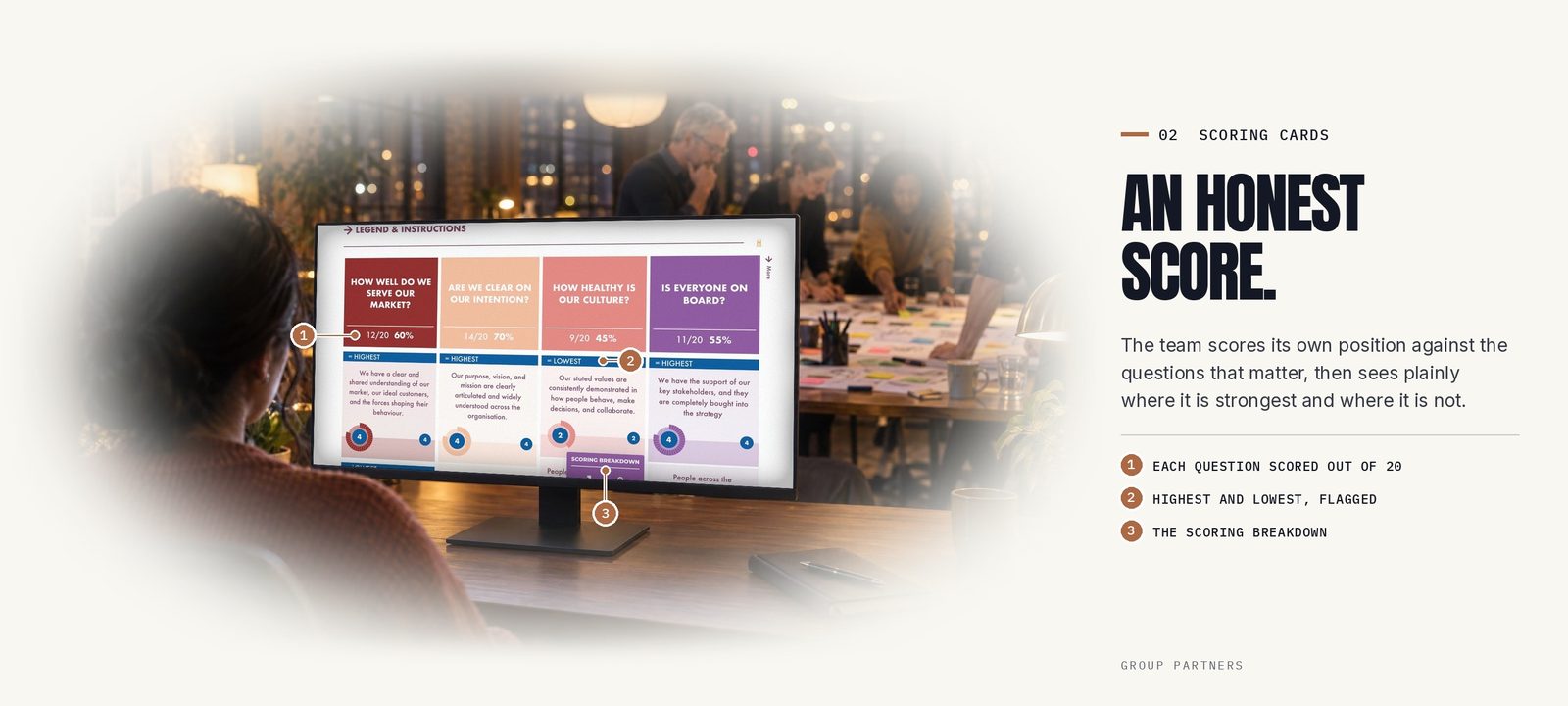
Hover the Assessments board to light one row at a time. Tap a row to see the leadership view next to the delivery view, as positions, not numbers.
Script notes: visual
Real Assessments board, scrolling down slowly enough to read as texture rather than data. No figures called out on screen. Close on a mood shot of one person scoring alone.
The story
Described or declared. The trap we meet most often is a strategy that has been described and never declared. Agreement is easy when no one knows precisely what they are agreeing to.
Kept in reserve. The options set aside are recorded as reserve positions, so when a trigger fires the team returns to them calmly. Treating every wobble as a rethink is as costly as treating a real shift as a wobble.
The same assessments. The declaration is scored with the same assessments used in the groundwork, each person alone. When leaders and the people delivering disagree, the delivery view is almost always closer to the truth.
Decision quality. It shows in what happens next: fewer choices made sooner by the people who will carry them out. Six months later the reasons are still visible when someone asks why.
The trap is constant: a strategy that has been described but never declared. A description is easy to agree with because it commits nobody. A declaration commits specific people to specific things, and they know it.
Compression is what makes declaration possible. Stage by stage, the material is sorted against the question until the remaining choices are few enough to be argued properly.
The ones set aside are not deleted. They are recorded as reserve positions, so that when a trigger fires the team returns to options it already understands rather than starting again in a panic.
Triggers also keep the difference clear between an operational adjustment and a strategic pivot. They are different things.
Treating every wobble as a rethink is as costly as treating a real shift as a wobble. A trigger written down in advance makes the difference visible when it matters.
Decision quality shows in what happens next: fewer choices, made sooner, by the people who will carry them out, with the reasons still visible six months later when someone asks why.
DESCRIBED ≠ DECLARED
DECISION QUALITY = FEWER, BETTER CHOICES, MADE SOONER, BY THE PEOPLE WHO WILL CARRY THEM OUT
Four stages
- 01 Everything we know: reports, data, opinion, research
- 02 What bears on the question: sorted into the equation
- 03 The choices that remain: with alternatives and trade offs recorded
- 04 The decision: declared, with the reasons in view
Four tests of a declaration
- A It excludes: what we will not do is stated
- B It moves resources: money and people follow the choice
- C It names owners: specific people, committed to specific things
- D It states triggers: what would make us think again
Side note
- Kept, not discarded: the alternatives, recorded as reserve positions for later
Proof
- The declaration is tested before anything is rolled out: each person scores it alone, across eight layers (dynamics, identity, intent, position, economics, delivery and proof, risk and assumptions, commitment). The signal watched hardest is the gap between levels: when senior people score it complete and the people who must deliver it score it far lower, it has only been announced.
Sources: Strategic Health Assessments v4; Strategy Declaration Self-Assessment
Evidence
After we leave
The ship sails on.
The measure of the work is what happens after we leave.
Act III · Mezzanine
The ship sails on.
The measure of the work is what happens after we leave.
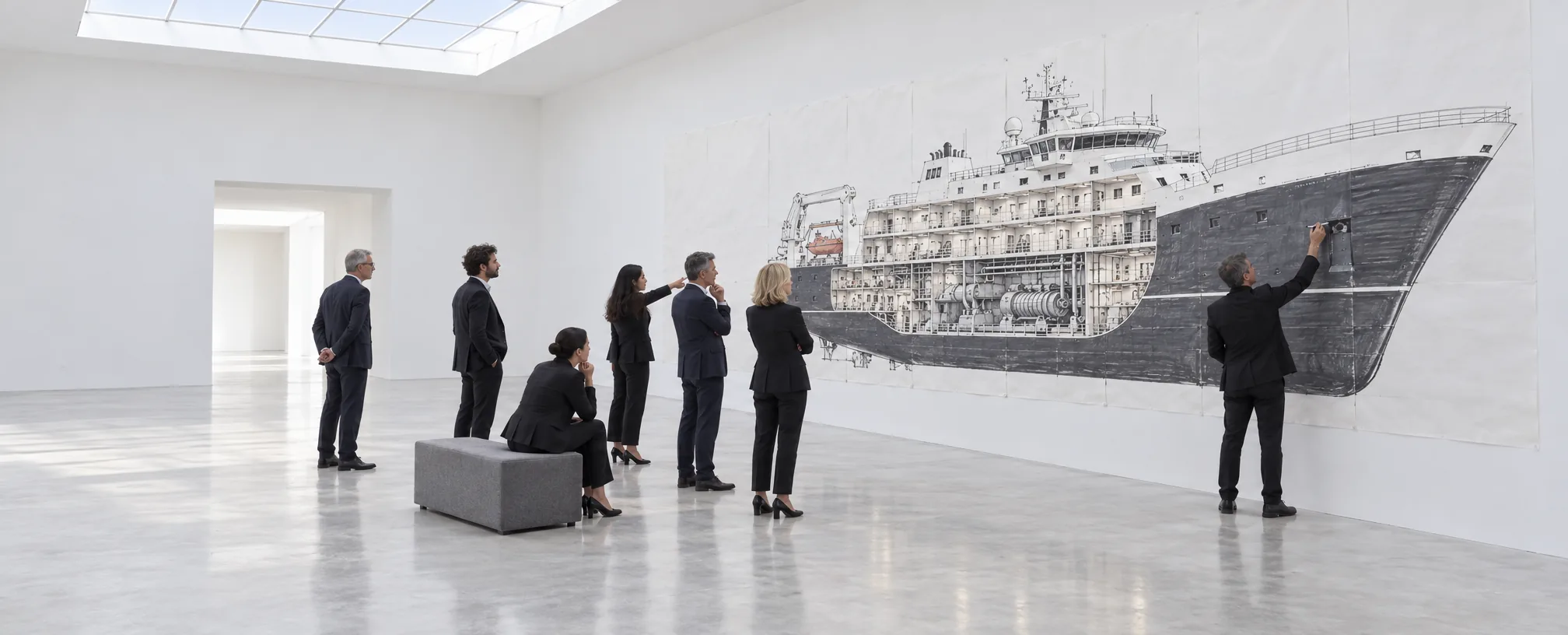
And then we leave. The team carries on under its own power, with the question, the frameworks, the reasoning and a roadmap with names against it. They review against what they declared, they watch the triggers they set, and when something real changes they know where to go back to.
At the end, someone has to say honestly whether the question was answered. Most engagements skip that part. We write it in from the first day.
Nobody archives a way of knowing; someone has to teach it forward, and by now they can. The ship sails on.
Put the date in the diary now for the review where someone will say whether your question was answered.
Choose where to go next: watch a snack, open what a client keeps, or talk to us.
Script notes: visual
Mood shot: a client team in their own offices, no Group Partners figure present, the drawn deliverables pinned up and Mezzanine on the screen beside them. Slow pull back to wide, then the closing card.
The story
And then we leave. The team carries on under its own power, with the frameworks and a roadmap with names against it. A strategy that works becomes a steering instrument, a document people actually open.
The verdict. At the close, someone has to say whether the question was answered. Written in from the start, it keeps everyone honest throughout.
Launching the ship. The sessions and what we leave launch the ship. Where a client has chosen Mezzanine, it keeps the thinking in daily use and keeps the ship on course.
Teaching it forward. Capability without dependency is what helping clients help themselves means in practice. That is the last piece of work, and the measure of all the rest.
A strategy that works becomes a steering instrument, not a document nobody opens. The team keeps adding evidence as it happens, reviews against what it declared and watches the triggers it set.
When a trigger fires, it returns to options it already understands. The roadmap carries names, dependencies and measures, so progress can be read by anyone, not only by the people who wrote it.
The verdict matters. At the close, someone has to say whether the question was answered.
Most engagements skip it. Written in from the start, it keeps everyone honest throughout.
The practitioner's work was visible to the team throughout, so by the end the background craft is theirs too: choosing the questions, keeping the frameworks current, knowing when to go back. Capability, not dependency. That is what helping clients help themselves means in practice.
Nobody archives a way of knowing. Someone has to teach it forward. That is the last piece of work, and the measure of all the rest.
CAPABILITY, NOT DEPENDENCY.
What the crew carries
- 01 The question: and, in time, its verdict
- 02 The reasoning: why each choice was made, and what was set aside
- 03 The roadmap: owners, dependencies, measures
- 04 The triggers: what would make them think again
- 05 The practice: they can run the next round themselves
The loop
- Review: against what was declared
- Learn: capture what changed
- Return: to the stage that produced it
Note
- The crew: it belongs to them
Sources: The Floor Above the Work: the loop, return paths and triggers
Evidence